
Microsoft Changes

For Microsoft CSP partners, the question is no longer whether subscription billing can be automated. It is how to govern recurring revenue as the business scales across more clients, more vendors, and constant pricing change.
Recurring revenue now sits at the center of the Microsoft partner economy. A growing CSP partner can carry tens of thousands of subscriptions across dozens of distributors and vendors, each with its own pricing files, renewal cadences, and billing cycles. And critically, reconciliation does not happen in one place. It unfolds across extended, multi-system processes that were never designed to operate in sync.
Where past efforts often fell short, adding more spreadsheets, more headcount, or bolt-on scripts, a different approach is changing what is possible. Treating subscription operations as a governed layer, rather than a monthly reconciliation scramble, lets partners coordinate billing accurately, auditably, and at scale.
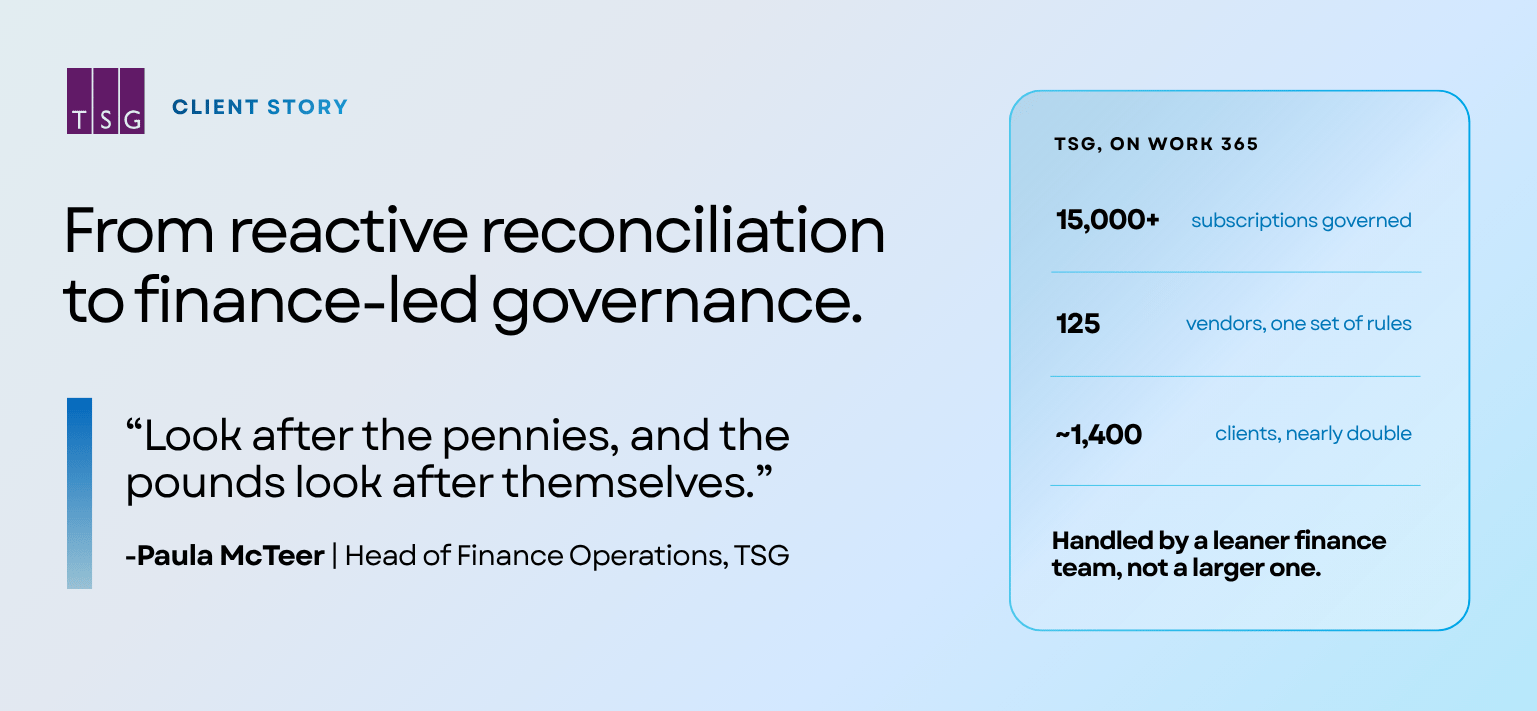
This shift is best understood through four ways it changes how a CSP partner operates. The clearest worked example is TSG, a UK managed services provider and Microsoft Solutions Partner that grew to more than 15,000 subscriptions across 125 vendors while making its finance operations leaner, not larger.

From human middleware to one governed model
In many CSP finance teams, people function as human middleware. They manually align vendor data that the systems themselves cannot easily connect: distributor pricing files, Partner Center changes, renewal adjustments, and customer invoicing cycles that rarely line up.
Before Work 365, that was TSG's reality. Reconciliation was spreadsheet-driven, roughly four weeks of full-time work for seven to eight people each month, plus a separate team for renewals and price changes. Every supplier had its own quirks, so accuracy depended on people remembering them.
A governed model changes the starting point. Subscriptions flow from sales orders into one hub for customers, contracts, products, and pricing, and every supplier runs through the same set of rules.
.png?width=721&height=298&name=TSG%20Case%20Study%20(updated).png)
Work 365 brings standardisation irrespective of who the supplier is.
Paula McTeer, Head of Finance Operations, TSG
The result is not less work for its own sake. It is consistent work, applied the same way across 125 vendors, so accuracy no longer depends on individual knowledge.
From periodic catch-up to real-time synchronisation
Manual update cycles hide surprises. When a price change or a subscription edit only surfaces during the monthly close, the team spends its time investigating variances rather than preventing them.
Real-time CSP synchronisation moves that work earlier. Subscription and supplier data stay current automatically, with distributor sources syncing into the governance layer rather than waiting for the next export. Changes become visible when they happen, not weeks later.
For a portfolio the size of TSG's, that timing difference is the difference between structured renewal handling and a recurring scramble.
From error firefighting to controlled, traceable billing
Billing accuracy has tended to be a firefighting exercise. Someone catches a duplicate or a missed price change, investigates it, recreates the logic, and corrects the invoice, usually while trying to close the month.
When billing becomes a controlled process, that pattern changes. Subscription-level traceability makes every charge explainable, and margin confidence is built into the workflow instead of checked after the fact.
Watertight billing. That nervousness around revenue leakage has gone away.
Paula McTeer, Head of Finance Operations, TSG
The result is a shift from reactive correction to provable control, where finance can stand behind the numbers because the process, not a person's memory, holds them together.
From linear headcount to scalable operations
Growth in CSP operations has historically been capped by cost, because cost scaled with it. More subscriptions meant more people and more risk.
This is where the governed model pays off. TSG's numbers tell the story.
%20(1).png?width=669&height=425&name=TSG%20Case%20Study%20(updated)%20(1).png)
Nearly double the clients and 36% more subscriptions, handled by a smaller team.
We couldn't realistically consider scalability without a solution like this.
Paula McTeer, Head of Finance Operations, TSG
TSG is not alone in the pattern. Innovia Consulting grew its CSP business 300% without adding headcount, and Infinity Group reported 60% growth on a flat team alongside £1.5 million in operational savings. Across very different partners, the same principle holds: when operations are governed, revenue can grow without operations growing in lockstep.
From manual control to finance-led governance
Experienced finance and operations leaders are right to be skeptical of tooling that promises to fix everything. The difference here is not automation alone, but fit. A governance layer aligns with how CSP billing actually works: many suppliers, constant change, and exceptions that need judgment.
Platform matters too. Built natively on Microsoft Dataverse and Power Platform, Work 365 keeps subscription governance inside the same secure, auditable environment finance teams already trust, which is what makes the control provable rather than promised.
That is the real outcome for TSG. The company did not just automate billing. It built a finance-led operating model for subscription revenue, with margin protection under pricing volatility and operations that scale without linear headcount growth. As Paula McTeer put it, "Look after the pennies, and the pounds look after themselves."
For CSP partners weighing how to grow, that is the shift worth planning for: from reconciliation as a monthly event to governance as a permanent capability.
See what finance-led governance looks like:
Work 365 standardises subscription billing across every vendor, so revenue scales without scaling headcount.
