A Microsoft CSP can invoice every customer correctly and still lose margin. The reason is simple: the price you charge and the cost you ultimately incur do not always move together. This becomes particularly important when a CSP operates across multiple currencies. Individually, each difference can look small. Across hundreds or thousands of subscriptions, those differences can quietly become margin leakage.
What is FX margin leakage in CSP billing?
FX margin leakage happens when changes in foreign exchange rates reduce the difference between what a CSP pays for a product or service and what it charges the customer. Consider a simple example. A CSP sells a service to a UK customer for £100 per month. Its supplier cost is €100 per month. When the customer price is established, assume €100 costs the CSP £85.
Now assume currency movement means the same €100 supplier cost becomes £90. The customer is still paying £100. Nothing appears wrong with the invoice.
The customer invoice is correct. The supplier invoice is correct. The subscription is correct. The margin simply is not what the CSP expected. That is what makes FX-driven margin leakage difficult to spot.
Why this matters for Microsoft CSPs
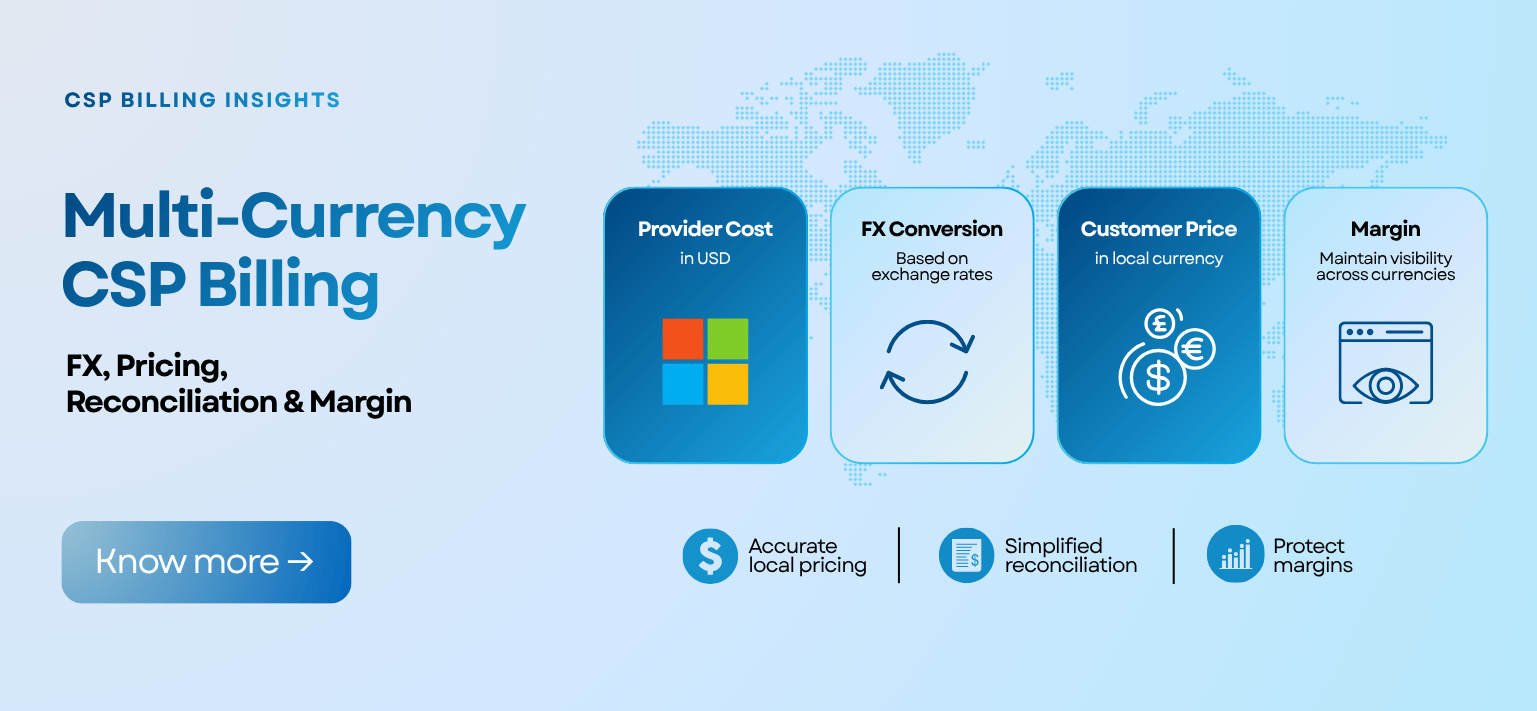
Microsoft CSP billing can introduce multiple currency relationships. Microsoft distinguishes between pricing currency and billing currency across its products. Azure pay-as-you-go, Azure reservations and Azure savings plans are priced in USD, while partners are billed in their applicable partner-location currency. Microsoft notes that FX can affect subscription costs when billing currency differs from product pricing currency. The CSP then introduces another commercial relationship:
The customer does not necessarily share the same pricing structure or currency relationship the CSP has with its supplier. That leaves two different financial calculations — what a subscription costs us, and what we charge the customer — with margin living in between.
The rate on today's pricing page is not necessarily the rate on your invoice
For Azure under Microsoft Partner Agreements and Microsoft Customer Agreements, Microsoft states that first-party Azure prices are shown in USD. Where supported local currencies are used, monthly cost is first calculated in USD and then converted into local currency. Microsoft captures an exchange rate around the end of the preceding month and applies that rate to transactions during the upcoming month.
Do not assume a current currency conversion tells you what Microsoft actually billed. Microsoft cautions that conversions returned by its Retail Prices API can be estimates based on the current rate and may not match the invoice when used for reconciliation. The authoritative question is not what a euro is worth today — it is what exchange rate was actually applied to this charge.
There can be more than one FX event
Currency complexity can extend beyond a single conversion. Microsoft's Marketplace documentation gives examples where an offer is priced in one currency, presented in another, billed in another and paid out in another. When market currency differs from billing currency, an additional conversion can occur during invoicing, so a single commercial transaction can involve multiple FX conversions.
For CSPs and other Microsoft partners, that suggests a more useful question. Instead of asking only whether you support multiple currencies, ask where currency conversion occurs across your revenue chain, because every conversion point can affect the economics of the transaction.
Fixed customer prices can create variable margins
This is where the problem becomes commercial rather than technical. Imagine a CSP has agreed to charge a customer €5,000 per month for 12 months. The customer's agreement does not automatically change every time an exchange rate moves, but some of the CSP's underlying costs may. Customer revenue is relatively fixed while supplier cost is potentially variable, which produces variable margin. Sometimes currency movement works in the CSP's favor, sometimes it does not. The point is not that rates move. It is knowing what those movements are doing to margin at the customer and subscription level.
Small FX movements matter when margins are already thin
A few percentage points can look insignificant until they are applied to a large book of recurring revenue. Imagine a CSP with £5 million in annual CSP revenue and an expected 15% gross margin. That represents £750,000 of expected gross margin. Now imagine cost movement equivalent to only 2% of revenue is not recovered through customer pricing. That is £100,000, and expected gross margin falls from £750,000 to £650,000.
A 2% cost movement became roughly a 13% reduction in the expected gross-margin pool. A small cost variance can have a much larger impact on profit when the margin between cost and selling price is relatively narrow.
FX is not the only variable
Currency is harder to manage because it does not move independently of everything else. A CSP may simultaneously see a Microsoft price change, an FX movement, a distributor discount change, a customer discount, a promotion expiry, seat changes, credits and renewal pricing. Consider a subscription where the supplier price rises 5% while currency movement adds another 2% to the effective local cost, and the customer remains on an older selling price. Finance may see that the Microsoft price changed. What is not always obvious is the combined margin impact. That is why margin management cannot rely only on checking price lists. Finance needs to compare expected economics with actual economics.
The real problem is identifying which customers are affected
Knowing that GBP moved against USD is not particularly useful by itself. Finance needs to know which subscriptions are USD-priced, which customers are billed in GBP, what customer price is in use, what cost was expected, what Microsoft actually charged, what margin was expected, what margin was actually achieved, and which customer contracts allow a price adjustment. That turns currency monitoring into something actionable.
Instead of "USD moved 3%," finance gets "these 47 subscriptions have fallen below our target margin." The second statement can drive a business decision. The first usually cannot.
Customer-level margin matters more than portfolio averages
Portfolio-level margin can hide problems. Imagine two customers with the same 15% expected margin.
Customer A
Customer B
The average is a healthy 15%. At customer level, one account is substantially underperforming. The same pattern can exist at SKU level, currency level, distributor level and subscription level, which is why CSPs benefit from investigating margin at multiple levels rather than relying on an overall percentage.
Reconciliation is where hidden leakage becomes visible
Reconciliation should do more than confirm Microsoft charged for the correct number of licenses. A stronger process connects the full chain:
For each subscription, finance should be able to establish:
| Control | Question |
|---|---|
| Supplier cost | What were we actually charged? |
| Pricing currency | What currency was the underlying product priced in? |
| Billing currency | What currency were we billed in? |
| FX rate | What conversion was actually applied? |
| Customer price | What did we charge? |
| Customer currency | In what currency? |
| Expected margin | What did we plan to make? |
| Actual margin | What did we make? |
| Variance | Is investigation required? |
The objective is not to review every line by hand. It is to surface the exceptions.
A better approach: manage margin by exception
Imagine a CSP processing 20,000 subscription lines. Finance should not have to inspect all 20,000. Instead, the business can define controls — for example an expected margin of 15%, a warning threshold below 13% and a critical threshold below 10%. Reconciliation can then focus attention where it is needed:
Finance can investigate the 1,060 exceptions instead of reviewing the entire book. That is a fundamentally different operating model. The goal of automation is not simply to process billing faster. It is to tell people where human attention is required.
Pricing governance is the other half of the problem
Reconciliation tells you what happened. Pricing governance helps prevent the same problem from continuing. A CSP operating across currencies benefits from a defined process for a few questions: how often do we review FX exposure, when does a currency movement trigger a price review, which exchange-rate methodology do we use, do we maintain currency-specific price lists, how much margin buffer do we build into customer pricing, when can customer prices change, and do renewals automatically trigger a margin review. Without those controls, pricing becomes reactive. A better model makes margin review part of the commercial lifecycle.
Renewals are natural margin-control points
Renewals are not only subscription-management events. They are opportunities to validate the economics of the customer relationship. Before renewal, finance and operations can review current supplier cost, current customer price, the current FX relationship, current discount, expected future cost, actual margin and target margin. That gives the CSP a chance to address accumulated cost and currency changes before entering another commitment period. In that sense, renewal dates are financial control points, which connects multi-currency management with broader CSP renewal governance.
What should CSP finance teams monitor?
A practical FX and margin-control process does not require anyone watching currency markets every day. Instead, CSPs can monitor the commercial consequences. A useful monthly review could include:
- Margin outliersSubscriptions below target margin, and the largest margin declines.
- ExposureCustomers with significant FX exposure, and currencies with material exposure.
- Cost driftProducts with changing supplier costs, and differences between expected and actual supplier costs.
- TimingUpcoming renewals with margin below target, and customers on legacy pricing.
That turns FX from a market-data problem into an operational finance process.
How Work 365 connects cost, billing and margin
Work 365 recon-based margin visibility
For Microsoft CSPs, the challenge is not merely calculating an exchange rate. It is connecting the commercial data around the subscription. Work 365 brings together the product catalog, subscriptions, pricing, billing and reconciliation processes used to operate a CSP business. Partners can manage pricing and invoicing across currencies and legal entities while reconciling customer billing against Microsoft and integrated provider charges.
The objective is one connected financial flow:
Instead of relying on disconnected spreadsheets to judge whether customer economics still make sense, finance teams can operate from a governed billing and revenue process. To see it in context, explore the CSP billing platform, Azure usage billing, and the companion guide on multi-currency CSP billing.
FX risk is ultimately margin risk
Microsoft CSPs do not need to become currency traders. They need to understand how currency affects the economics of the products they sell. The question is not whether the exchange rate changed — it almost certainly did. The more useful questions are which customers it affected, by how much, whether the customer is still within target margin, and when the business can act on it. When supplier cost changes but customer pricing does not, the difference has to go somewhere. It usually comes out of margin, and the opportunity is to see that clearly enough to act with confidence.