Microsoft Changes

Enterprise Microsoft CSPs face a fundamentally different set of challenges than their smaller counterparts. You are not trying to get billing off spreadsheets. You solved that years ago. You are not trying to build a sales motion. You have one — and it works.
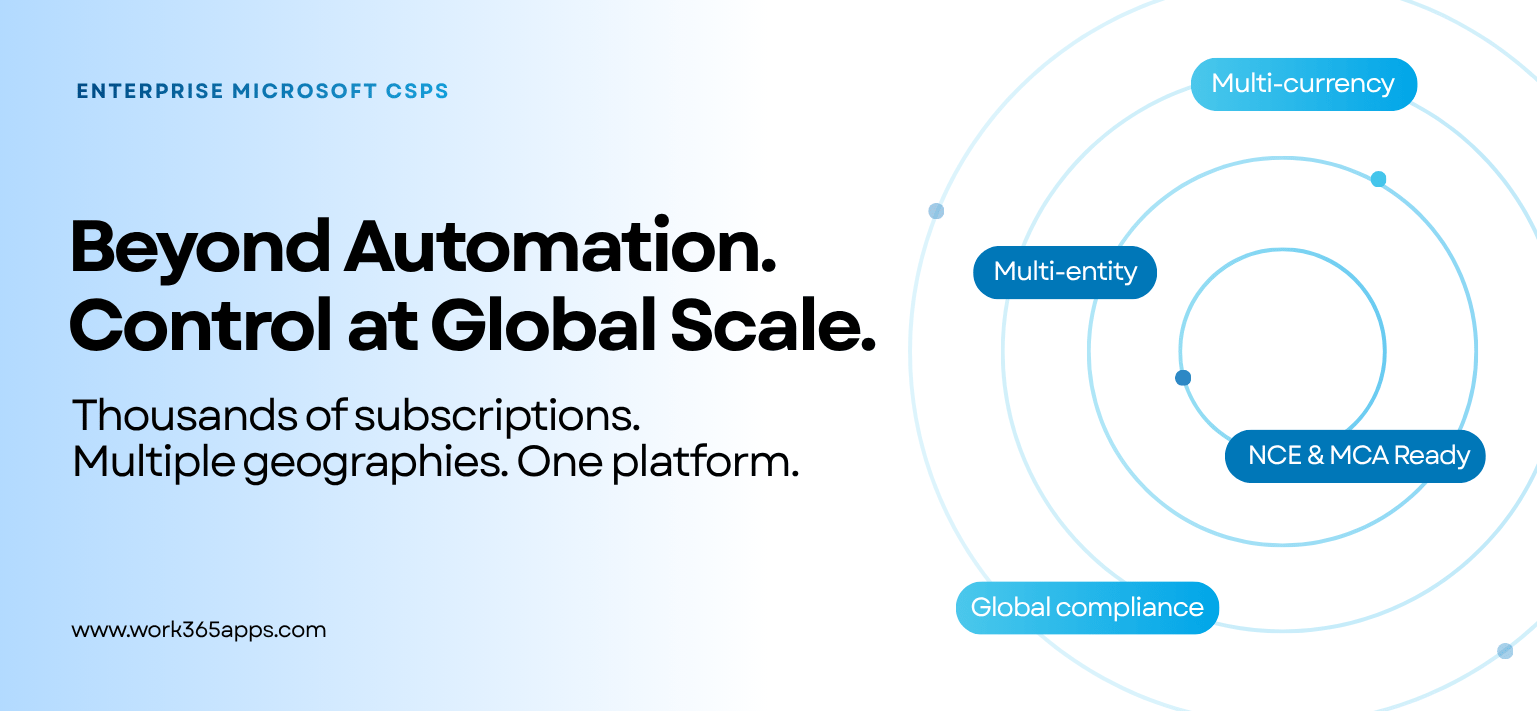
Your challenge is governance at scale. You are managing thousands of subscriptions across multiple entities, geographies, currencies, and regulatory environments. You have subsidiaries with different billing requirements. You have enterprise customers whose own complexity rivals yours. And you have a Microsoft partner relationship that demands consistent performance, compliance, and commercial excellence across the entire portfolio.
At this level, the question is not "how do we automate?" You are already automated. The question is: "How do we maintain precision, compliance, and strategic visibility across an operation that is too large for any individual to see end-to-end?"
This guide is written for the operations leaders, finance directors, and technology executives at enterprise Microsoft CSPs who are wrestling with exactly that challenge.
Challenge 1: Multi-Entity Billing Without Losing Central Control
Enterprise CSPs often operate across multiple legal entities — regional subsidiaries, acquired businesses, or white-label partner brands — each with their own billing requirements, pricing structures, tax obligations, and customer relationships.
The tension here is real: each entity needs enough autonomy to serve its local market effectively, but finance and operations leadership needs consolidated visibility and control across all of them. Without the right infrastructure, enterprise CSPs end up with a patchwork of disconnected billing systems that make group-level reporting nearly impossible and create serious reconciliation headaches at month-end.
What enterprise-grade multi-entity billing requires:
- A single platform that supports multiple business units with independent billing configurations — separate invoice templates, pricing rules, payment terms, and tax settings — while maintaining a unified data layer for group reporting.
- Intercompany billing workflows that handle cost allocation and internal chargebacks when one entity provisions on behalf of another.
- Consolidated MRR and margin reporting across all entities — with the ability to drill down to the subsidiary, customer, or subscription level.
- Role-based access controls that give regional teams visibility into their own data without exposing cross-entity financials inappropriately.
Work 365 supports multi-entity CSP operations natively, enabling enterprise partners to manage billing across subsidiaries and tenants from a single platform — with both local flexibility and group-level control.
Challenge 2: Managing Enterprise Customer Complexity
Enterprise CSPs do not just sell to enterprise customers — they inherit their complexity. A single enterprise customer may have hundreds of cost centers, multiple subsidiary tenants, bespoke contractual terms negotiated outside standard Microsoft pricing, and internal procurement teams who expect their Microsoft spend to be allocated and reported in ways that align with their own financial systems.
Serving these customers well — and retaining them — requires billing and subscription management infrastructure that can match their level of sophistication.
Key capabilities for serving enterprise customers at scale:
- Custom billing schedules and invoice formats that match the customer's internal finance requirements — not a standard template.
- Granular cost allocation by department, cost center, project, or subsidiary — so enterprise customers can distribute Microsoft spend internally without relying on your team to break it down manually.
- Contractual pricing management — the ability to honor bespoke pricing agreements, volume discounts, and custom terms at the customer level without breaking your standard billing processes.
- Executive-level reporting portals that give enterprise customers real-time visibility into their Microsoft spend, usage trends, and licensing health — branded to your practice.
Challenge 3: Compliance, Security, and Regulatory Governance
Enterprise-scale Microsoft partners operate in an environment of increasing regulatory complexity. GDPR in Europe, data residency requirements in regulated industries, Microsoft's own GDAP compliance mandates, and customer-specific security requirements all create a governance burden that smaller CSPs rarely have to contend with.
Getting this wrong is not just an operational problem — it is a commercial risk. Enterprise customers increasingly require evidence of compliance posture as part of vendor selection and annual reviews. And Microsoft's own partner requirements around GDAP, customer attestation, and performance standards are tightening.
Governance priorities for enterprise CSPs in 2026:
- GDAP fully implemented across all customer tenants — with role assignments documented, access scoped to minimum privilege, and a defined review cycle for delegated permissions.
- Microsoft Customer Attestation (MCA) compliance processes that are systematic, not manual — especially as Microsoft tightens enforcement timelines.
- Audit trails for all billing changes, subscription modifications, and provisioning actions — essential for both internal compliance and customer-facing dispute resolution.
- Data residency controls that ensure customer data is processed and stored in accordance with applicable regulations — particularly for customers in healthcare, finance, and government sectors.
- Tax compliance automation — particularly for enterprise CSPs operating across multiple jurisdictions with different VAT, GST, and sales tax regimes.
Forward-thinking enterprise CSPs treat compliance infrastructure not as a cost center but as a competitive differentiator. The ability to demonstrate robust governance to enterprise customers is increasingly a decisive factor in partner selection — and in winning renewals.
Challenge 4: Azure Billing Precision at Enterprise Volume
Azure consumption billing is uniquely complex at enterprise scale. You are not dealing with a few customers on modest Azure spend — you are managing millions of dollars in monthly Azure consumption across hundreds of customers, each with their own reservations, savings plans, custom markup rules, and cost optimization commitments.
At this volume, even a 1% billing error rate represents significant revenue leakage. And enterprise customers have sophisticated FinOps teams who will notice discrepancies, challenge invoices, and escalate billing disputes to executive level if they are not handled quickly and accurately.
Enterprise Azure billing requirements:
- Automated ingestion and reconciliation of Azure consumption data at line-item level — not just summary totals.
- Flexible markup rules by customer, subscription, resource group, or service category — with the ability to honor negotiated rates and custom pricing arrangements.
- Reserved Instance and Savings Plan attribution — ensuring that discounts are correctly passed through (or retained) according to customer agreements.
- Anomaly detection that flags unusual consumption spikes before they become billing surprises for your customers.
- Customer-facing Azure cost dashboards that give enterprise FinOps teams real-time visibility into their cloud spend without requiring them to call your account team.
Challenge 5: Strategic Visibility Across a Portfolio of Thousands
At enterprise scale, leadership cannot be in the details. But they still need to be in control. The challenge is building reporting and analytics infrastructure that surfaces the right information to the right people — without requiring an army of analysts to produce it.
Enterprise CSP leadership teams need visibility at three distinct levels, simultaneously:
- Portfolio level: Total MRR, ARR, gross margin, and renewal health across the entire business — updated in real time, not at month-end.
- Segment level: Performance by entity, region, customer tier, or product line — to identify where growth is accelerating and where margin is compressing.
- Account level: Individual customer health scores, renewal risk signals, upsell opportunities, and billing accuracy metrics — surfaced proactively to account managers, not buried in reports they have to pull manually.
Work 365's Power BI integration gives enterprise CSPs a unified analytics layer across their entire subscription and billing operation — enabling real-time portfolio visibility without custom development or data warehouse investment.
Challenge 6: Microsoft Frontier Partner Performance — Staying Ahead
Microsoft's Frontier Partner designation represents the upper tier of CSP partner performance — and for enterprise CSPs, maintaining that status is both a commercial priority and a competitive differentiator. Frontier Partners receive preferred treatment in co-sell motions, access to early Microsoft programs, and stronger positioning in enterprise deal cycles.
But Frontier status is not static. It requires consistent demonstration of performance across revenue growth, customer acquisition, and product adoption breadth. At enterprise scale, managing towards these metrics requires deliberate tracking and operational alignment — not just strong sales results.
How enterprise CSPs protect and advance their partner standing:
- Track Microsoft-defined performance metrics within your internal dashboards — not just in Partner Center — so the entire commercial team is aligned on what drives partner status.
- Systematically identify and act on FY26 Copilot and M365 promotions across your customer base — enterprise CSPs who move customers onto Copilot at scale are significantly advancing their product adoption metrics.
- Maintain GDAP compliance and attestation processes that meet Microsoft's evolving requirements without creating internal operational burden.
- Build a co-sell pipeline that is consistently active — enterprise CSPs who engage Microsoft sellers early in deal cycles close larger, stickier opportunities.
Challenge 7: Technology Architecture That Scales With the Business
Enterprise CSPs often arrive at a technology architecture that worked well at a previous scale but is showing its seams as the business has grown. Legacy billing systems that were never designed for multi-entity operations. CRM implementations that are not connected to billing or provisioning. Analytics environments that require manual data exports to produce basic reports.
The technology decisions enterprise CSPs make today will define their operational capacity for the next five years. The key principles for a future-proof enterprise CSP technology stack are:
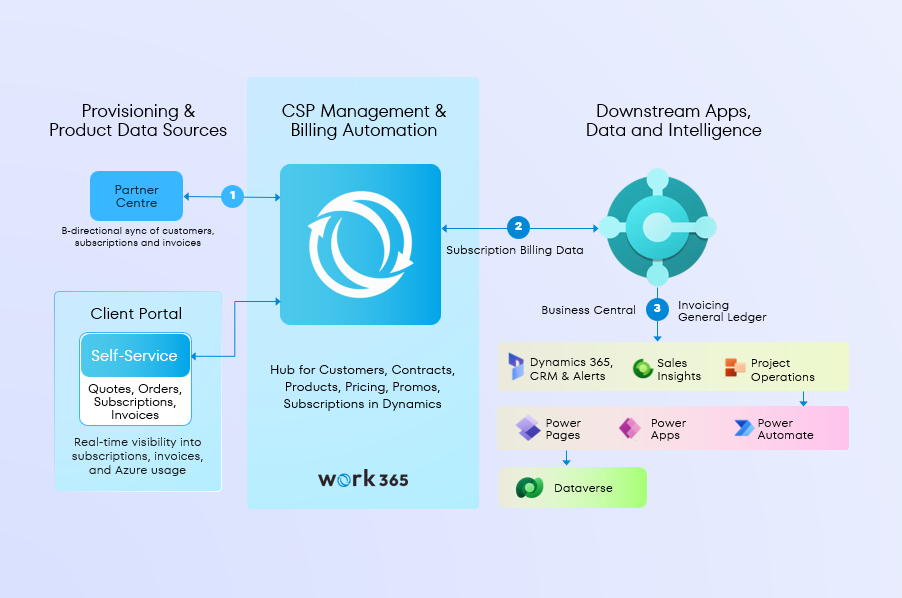
- Built on Microsoft's ecosystem: Platforms natively built on Dynamics 365 and the Power Platform inherit Microsoft's security model, data governance framework, and integration capabilities — removing significant build-and-maintain overhead.
- Single source of truth for subscription and billing data: Every system that needs subscription or billing data should draw from one authoritative source — not maintain its own copy that inevitably drifts out of sync.
- API-first integration architecture: Enterprise operations require deep integration with ERP systems (Business Central, Finance & Operations), PSA tools, tax engines, and payment processors. API-first platforms make these integrations maintainable as both sides evolve.
- Extensibility without customization debt: Enterprise needs are unique. The platform must be extensible enough to accommodate them without requiring deep customization that creates upgrade risk and long-term maintenance burden.

The Enterprise Mandate: Control, Compliance, and Commercial Excellence — Simultaneously
Enterprise Microsoft CSPs are playing a different game than their smaller counterparts. The stakes are higher, the complexity is deeper, and the margin for operational error is narrower. A billing mistake that is an inconvenience at 100 customers is a commercial incident at 1,000.
But the opportunity is proportionally larger too. Enterprise CSPs who get the operational infrastructure right — multi-entity billing, enterprise customer management, compliance governance, Azure precision, and real-time portfolio visibility — can grow their Microsoft practice without proportionally growing their operational cost base. That is where true scale economics come from.
The partners who will define Microsoft's enterprise channel in the next five years are not just the ones who sell the most. They are the ones who can deliver consistency, precision, and transparency at scale — to Microsoft, to their customers, and to their own leadership teams.
Work 365 is the enterprise-grade CSP management platform built natively on Microsoft Dynamics 365 and the Power Platform. From multi-entity billing and Azure cost management to customer self-service portals and real-time analytics, Work 365 gives enterprise Microsoft partners the infrastructure to operate with precision at any scale.
Ready to see how Work 365 handles enterprise-scale CSP operations?
Book a consultation with our enterprise team — we will map your current operational architecture to a scalable, compliant, and future-proof platform built for the way your business actually works.