Microsoft Changes

"If I move to indirect, do I lose the automation I have built?" It is the question we hear most often from partners thinking about the change. The honest answer is that nothing about how you run your business has to change. What changes is who you buy through, and that is a smaller shift than it feels.
This year more Microsoft CSP partners are looking at the indirect model, often prompted by Microsoft's updated direct-bill requirements. For a lot of them it is the right call. The hesitation is rarely about Microsoft. It is about the systems they have built around being direct, and whether those survive the move. This guide walks through the models, the new rules driving the shift, what genuinely changes, what does not have to, and how the transition actually works.
The three ways to transact in CSP
Microsoft's Cloud Solution Provider program supports three transactional relationships. Most conversations only mention two of them, so it is worth being precise (Microsoft Learn).
Direct-bill partner. You buy Microsoft products directly from Microsoft and sell them directly to your customers. You own the billing relationship, provide first-line support, integrate with Microsoft through APIs, and carry the program, security, and compliance obligations that come with it.
Indirect reseller. You keep the customer relationship and keep selling, but you do not bill Microsoft directly. You transact through a distributor, which lets you go to market with far less infrastructure and investment, and gives you access to a broader portfolio of Microsoft and non-Microsoft solutions.
Indirect provider (distributor). The distributor sits between Microsoft and the indirect reseller. Providers such as Pax8, Ingram Micro, TD SYNNEX, and Crayon buy from Microsoft at scale and enable resellers with billing, support, and marketing. When you go indirect, this is who you partner with.
The two models that a growing partner actually chooses between are direct-bill and indirect reseller. The rest of this guide is about moving between them.
What changed in 2026: the new direct-bill rules
Microsoft raised the bar for staying direct, and that is the single biggest reason partners are reassessing their model this year. Since October 2025, existing direct-bill partners face an annual reassessment in their CSP anniversary month, and must meet every one of the following to keep their authorization (Microsoft Learn).
01 Program membership and location
An active Microsoft AI Cloud Partner Program membership and a Partner Location Account ID for each region you sell in.
02 Revenue threshold
At least one million US dollars in trailing-twelve-month direct-bill CSP revenue at the Partner Global Account level. Indirect reseller revenue does not count.
03 Premium support plan
An active Advanced Support for Partners or Premier Support for Partners plan, renewed each cycle.
04 Security score
All mandatory Partner Center security requirements met, including multifactor authentication, a named security contact, and fast response to alerts.
05 Solutions Partner designation
At least one Solutions Partner designation in the partner program.
06 Annual reassessment
A yearly capability reassessment during your onboarding anniversary month, with advance notices starting three months out.
The consequence is the part to understand clearly. If a direct-bill partner does not meet these requirements at reassessment, Microsoft requires them to transition to indirect reseller status to keep transacting in CSP. The revenue threshold alone, one million dollars in direct-bill CSP revenue per Partner Global Account, is enough to move a meaningful number of smaller partners toward the indirect model. None of this is a penalty. It is Microsoft selecting for fewer, larger, more specialized direct partners, and pointing everyone else toward a model that carries less overhead.
What actually changes when you go indirect
Here is the honest side-by-side. Most of the differences sit in procurement and program mechanics, not in how you run the business day to day.
| Where it shows up | Direct-bill CSP | Indirect CSP |
|---|---|---|
| Who you transact with | Microsoft directly | An indirect provider that sits between you and Microsoft |
| Billing relationship | You bill Microsoft directly | You obtain subscriptions through your provider, not Microsoft |
| Where billing data comes from | Microsoft Partner Center | A distributor feed, alongside Microsoft data |
| Support model | You own first-line support and hold a premium support plan | The provider adds a support and enablement layer |
| Program requirements | The full FY26 bar, including the revenue threshold and reassessment | Active program membership, a location ID, and a provider relationship |
| Revenue minimum | One million dollars trailing-twelve-month at PGA level | At least one thousand dollars trailing-twelve-month at PLA level |
| Overhead to maintain | More to stand up and keep compliant | Lighter, with more handled upstream |
| How you run billing and renewals | Your operations platform | The same need, the source of truth just shifts |
Read the last row again, because it is the one that matters most. Whether you are direct or indirect, you still need to provision licenses, bill customers accurately, reconcile against the source, manage renewals, and give customers a way to serve themselves. That work does not go away. Only where the data originates changes.
How the transition works in practice
If you decide to move, the mechanics are well defined (Microsoft Learn). Knowing them up front takes most of the anxiety out of the decision.
- You transfer subscriptions to your provider. Indirect resellers do not bill Microsoft, so your existing direct-bill subscriptions move to your chosen indirect provider, using the self-serve subscription transfer in Partner Center.
- Microsoft recommends two tenants. You can run on one tenant, but enrolling as direct overrides indirect reseller features on the same tenant, so keeping a separate tenant for each model is the recommended setup.
- Your customers stay yours. The customer relationship does not transfer to the distributor. Customers accept the relevant agreements through the indirect provider, and you continue to own the account.
- There is a one-year wait to return. A partner who transitions to indirect must transact as an indirect reseller for twelve months before reapplying for direct-bill status, so the decision is worth making deliberately.
What does not have to change: your operating layer
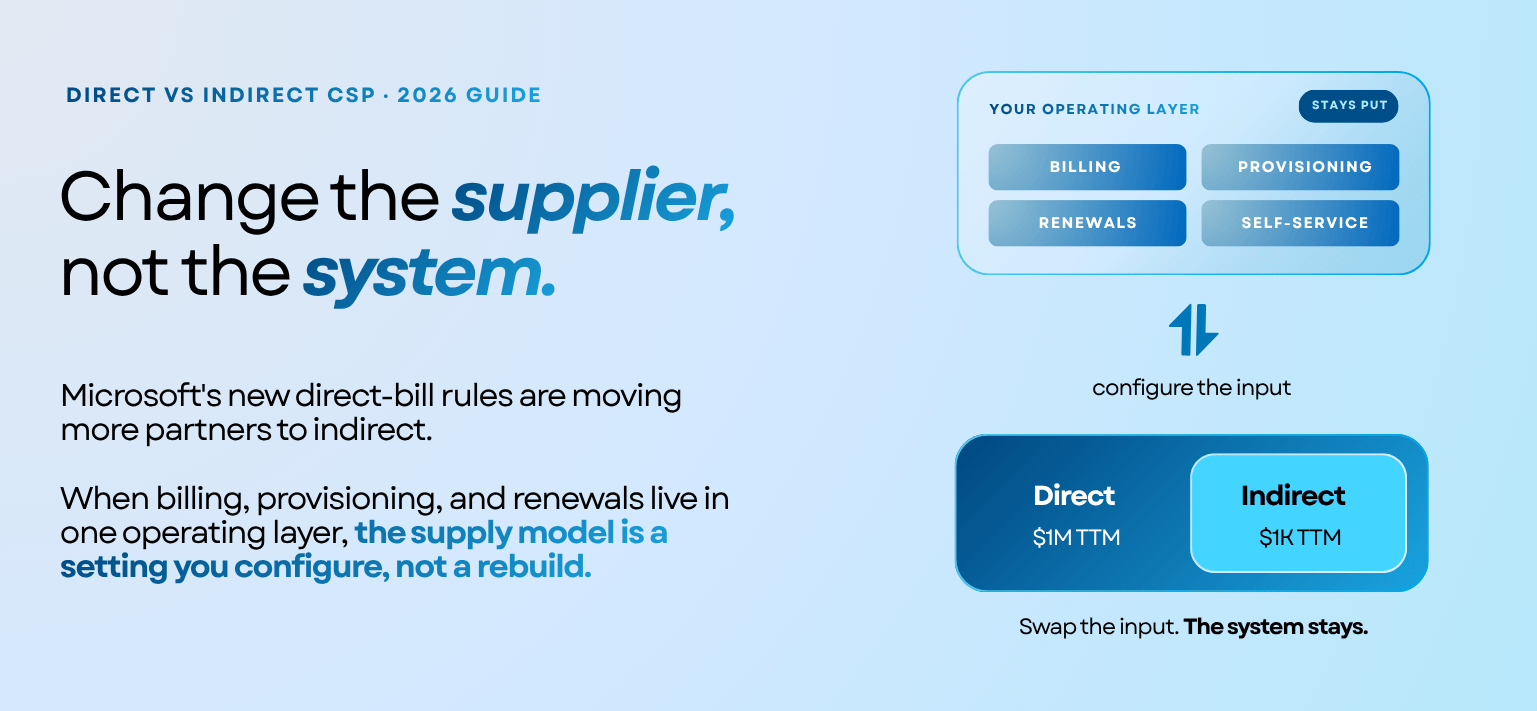
The mistake is treating an indirect move as an operations project. It is a procurement decision. If your billing and subscription management are tied directly to one supply model, then yes, switching feels like re-platforming. If they live in a layer that sits above how you transact, switching is closer to changing a setting. Three things are worth protecting.
Your operating layer, not just your supplier
Keep billing, provisioning, and renewals in one system, so the distributor underneath can change without your operations starting over. The supplier becomes a configurable input rather than the foundation everything is built on.
Reconciliation across sources
Indirect billing means your numbers now arrive from a distributor feed instead of direct from Microsoft. That is exactly where small discrepancies creep in. A reconciliation-first approach that ties every charge back to source data catches them before the invoice goes out, whichever way you transact.
Self-service that follows the customer
Your customers do not care whether you are direct or indirect. They want to manage their own subscriptions, renewals, and seat changes. That experience should follow the customer, not the supply chain, so the way they buy from you stays the same through any change you make behind the scenes.
Questions to ask before you switch
A short checklist to pressure-test your readiness, whichever direction you lean.
- If we changed providers tomorrow, how much of our billing and provisioning setup would we have to rebuild?
- Where does our billing data come from today, and can our system reconcile a distributor feed as cleanly as direct Microsoft data?
- Does our customer self-service experience depend on how we source licenses, or is it independent of it?
- Can we run direct and indirect side by side during a transition, without breaking reporting?
- How much manual work sits between a provider feed and a finished, accurate invoice?
Where Work 365 fits
Work 365 is the revenue and operations platform for Microsoft CSP partners. It is the layer your billing, provisioning, subscription management, and customer engagement run through, built natively on Microsoft Dataverse and Power Platform, with distributor integrations including Pax8, Ingram Micro, Crayon, Companial, TD SYnnex, etc.
That architecture is the point. Because the platform sits above how you transact, the supply model becomes an input you configure rather than the ground your operations stand on. Reconciliation ties charges back to the source whether that source is Microsoft or a distributor feed. And Work 365 Engen- Client Self Service Portal gives your customers a single storefront and self-service for upgrades, renewals, and seat changes, regardless of how you source the license. So, when your supply model shifts, your operations stay put. That is the difference between re-platforming and changing a setting.

The takeaway
Going indirect should change who you buy through. It should not change how you run your business. Get your operating layer right first, and the procurement decision becomes a lot less daunting.