
For Microsoft CSP partners, growth today comes with a strategic trade-off. Many partners are weighing the direct vs indirect CSP model - balancing margin, control, compliance, operational overhead, and speed to market. Some are staying direct to protect customer relationships and data. Others are leveraging distributors to reduce risk and complexity. Many are doing both.
The challenge isn’t choosing a side. The real challenge is operating efficiently across CSP models while Microsoft’s commercial complexity continues to increase.
Whether direct or indirect, CSP partners face the same operational realities:
-
Microsoft policy commitments and renewals
-
Frequent Microsoft price changes
-
Azure consumption and usage-based billing
-
Bundled services and recurring revenue contracts
-
Customers expecting transparency, self-service, and real-time visibility
Without a centralized Microsoft CSP billing automation platform, these pressures turn growth into operational drag - introducing revenue leakage, manual work, and fragmented customer experiences.
That’s why modern CSPs are rethinking how they manage billing, subscriptions, and revenue - moving away from spreadsheets and disconnected tools toward a Microsoft-native CSP management platform built for scale.
Revenue Leakage in CSP Billing Is More Common Than You Think
Across the Microsoft partner ecosystem, CSPs lose an average of 2–5% of annual revenue due to billing inaccuracies, missed renewals, and reconciliation errors.
For a $10M CSP business, that can mean:
-
$200K–$500K in lost revenue annually
-
Hours of manual rework by finance and operations teams
-
Customer trust erosion caused by incorrect invoices
And the hidden cost is even bigger: missed upsell and cross-sell opportunities because sales and licensing teams don’t have visibility into what customers already own. This is where modern CSPs begin to rethink their approach.
Billing Isn’t the Problem, Disconnected CSP Data Is
CSP billing errors rarely originate in billing systems alone. They start upstream:
-
License quantity changes
-
Renewal terms
-
Pricing updates
-
Azure usage consumption
-
Service bundles
When these events live in multiple tools: CRM, PSA, accounting, Partner Center; billing becomes reactive instead of automated.
Spreadsheets and siloed SaaS tools cannot support:
-
Subscription lifecycle management
-
Accurate Azure billing automation
-
Microsoft-aligned pricing strategies
-
Scalable renewal management
Modern CSPs need a single source of truth for revenue and subscription data.
Work 365: Microsoft CSP Billing Automation Platform Built on Power Platform
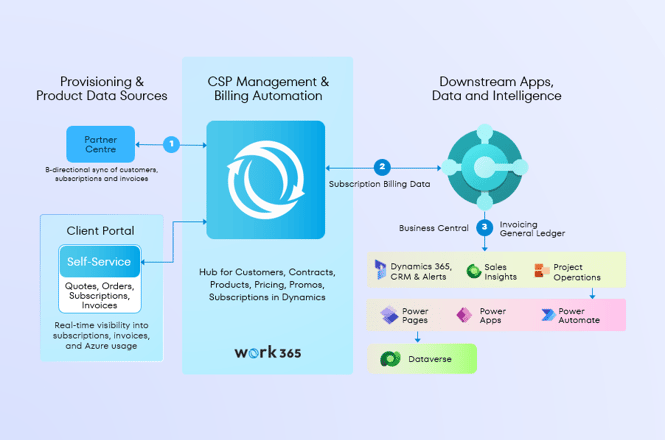
Work 365 is a CSP management and billing automation platform built natively on Dynamics 365 and Power Platform. Unlike standalone billing tools, Work 365 centralizes:
-
Microsoft CSP subscriptions
-
Azure usage and consumption data
-
Contracts, invoices, and renewals
-
Pricing, discounts, and markups
all inside Microsoft Dataverse. This allows CSP partners to automate billing while maintaining complete control over their data, workflows, and extensions.
Core Capabilities for CSP Billing and Revenue Management
Accurate CSP Billing and Revenue Integrity
Work 365 continuously compares invoices against actual license and usage data, minimizing reconciliation effort and eliminating revenue leakage.
CSP Subscription and Renewal Management at Scale
Track terms, commitments, and pricing per subscription, surface upcoming renewals, and apply Microsoft price changes in bulk without manual intervention.
Azure Billing Automation and Usage-Based Invoicing
Automate Azure consumption tracking and invoicing alongside licenses and services, reducing billing cycles from days to minutes.
Customer Self-Service for Microsoft CSPs
Provide customers with real-time visibility into subscriptions, invoices, and Azure usage while retaining governance through approval workflows and NCE controls.
One Microsoft CSP Catalog and Pricing Source
Align sales, billing, and operations teams with a centralized Microsoft catalog and consistent pricing strategies.

Why Power Platform Matters for Future-Ready CSPs
CSP platforms built outside the Microsoft ecosystem limit future growth. Work 365 is Dataverse-native, enabling partners to:
-
Extend workflows using Power Automate
-
Build custom apps with Power Apps
-
Enable Copilot and AI-driven insights
-
Maintain ownership of customer and revenue data
As Microsoft moves toward agentic operations and AI-powered workflows, CSPs running on non-Microsoft platforms will struggle to keep up. Frontier Partners are investing early in Microsoft-first foundations.
Proven Results from Microsoft CSP Partners
CSPs using Work 365 report:
-
Recovering billing errors within months
-
Identifying up to 30% invoice inaccuracies
-
Reducing manual billing effort by 75%
-
Scaling recurring revenue without adding headcount
-
Winning enterprise deals due to self-service and transparency
In one case, a large UK Microsoft partner, Infinity Group, saved £1M annually by consolidating systems and unifying CSP billing and revenue data.

Who Work 365 Is Built For
Work 365 supports:
-
Direct Microsoft CSPs
-
Managed Service Providers (MSPs)
-
Dynamics 365 partners
-
ISVs and systems integrators
-
Telcos and large IT service providers
Across teams:
-
Sales and customer success
-
Licensing and operations
-
Finance and accounting
All aligned on a single CSP revenue platform.
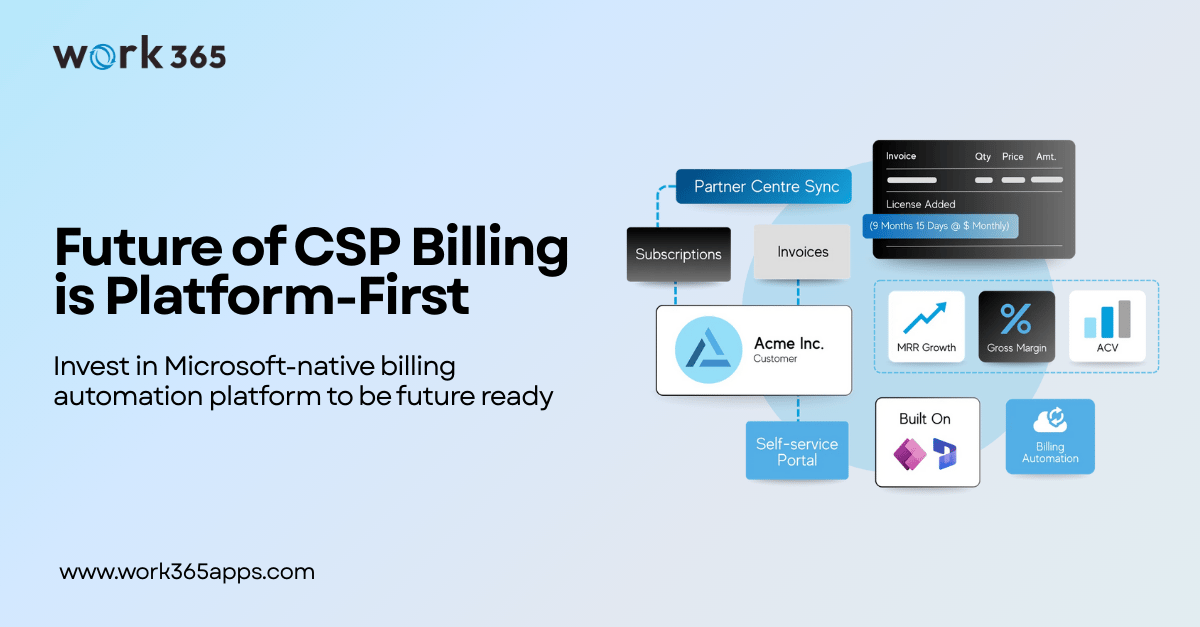
The Future of CSP Billing Is Platform-First
Microsoft CSP success is no longer about processing invoices faster. It’s about:
-
Protecting margins
-
Scaling recurring revenue
-
Delivering a modern customer experience
-
Being ready for Copilot and AI
CSPs that invest in Microsoft-native billing automation platforms today are positioning themselves as Frontier Partners for the future.
Ready to Modernize Your CSP Billing?
Work 365 helps Microsoft CSP partners automate billing, eliminate revenue leakage, and scale confidently on the Power Platform.
Explore Work 365 for Microsoft CSPs today.