
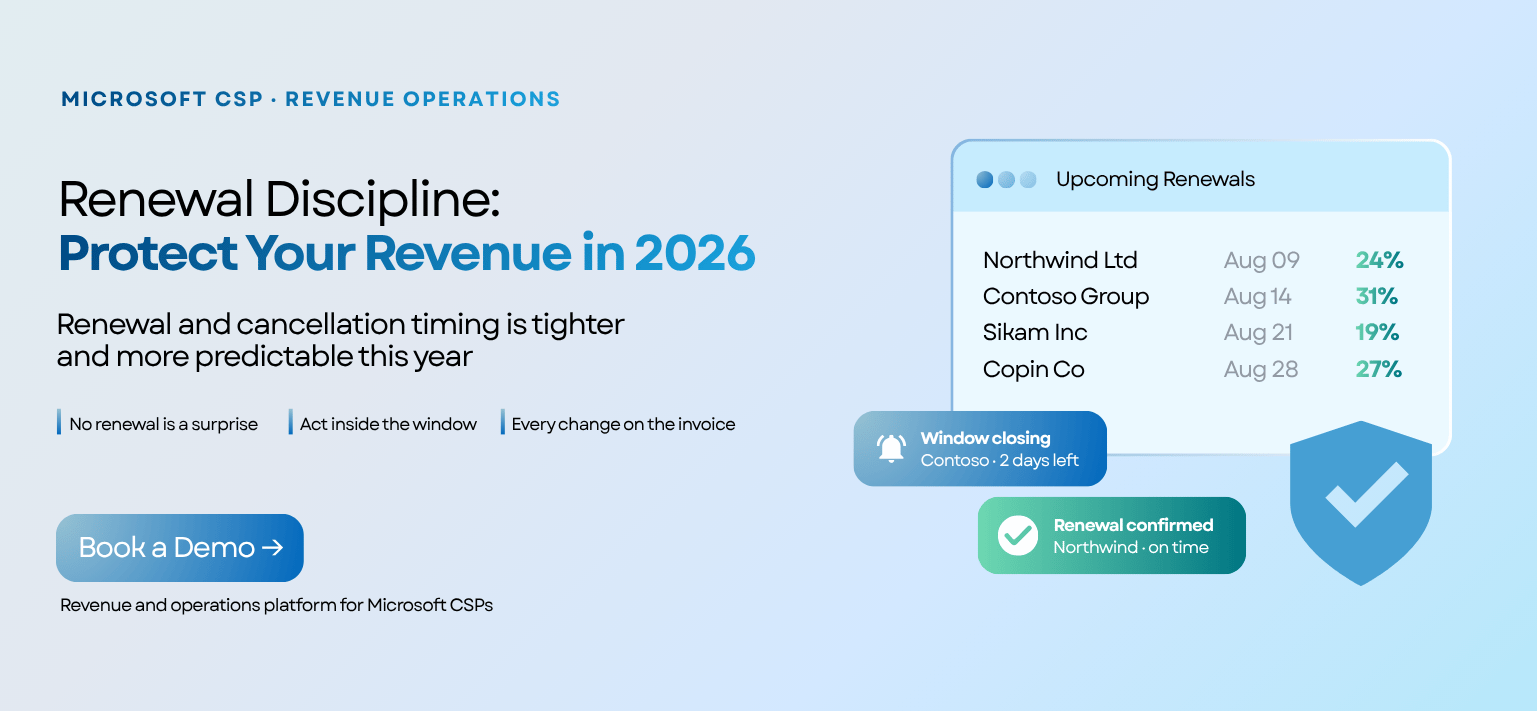

Every CSP business carries a quiet line item that rarely shows up in a forecast: revenue that slips away at renewal. A subscription that auto-renews when the customer meant to reduce seats. A cancellation request that arrives after the window closes. A seat change that never reaches the invoice.
Individually these look small. Across a book of hundreds of subscriptions, they add up to real margin. In 2026, the timing around renewals and cancellations has become firmer and more predictable. That is welcome news for finance leaders who value certainty, and it rewards the partners who have the right controls in place.
What changed, and what did not
Two Microsoft developments matter here, and they are distinct.
First, Enhanced Subscription Terms (EST) enforcement has been live since May 2026. When auto-renew is switched off, the previous 30-day grace period no longer applies. Cancellations and seat reductions now need to happen inside the defined window, commonly the seven days following purchase or renewal.
Second, Microsoft is moving its own partner benefits and designations to a renewal window that opens 30 days before the anniversary date, with the offer expiring the day after if it is not renewed. This applies to partner benefits packages and Solutions Partner designations, not to your customers' subscriptions. It does signal a consistent direction across the ecosystem: renewal timing is becoming firm and calendar driven.
EST is separate from the July 2026 pricing update, and it is unrelated to MCA attestation. Keeping the three straight helps your team communicate clearly with customers.
Provider specifics vary too. Some indirect providers enforce auto-renew and allow cancellation only inside a short window. Knowing each provider's rules is simply part of running clean renewals.
Where revenue actually leaks
For the operations and billing team, the leak points are familiar. None of them reflect a lack of effort. They are what happens when renewal timing is managed across spreadsheets, email, and several provider consoles at once.
- Auto-renew misfiresA subscription renews at full quantity when the customer intended to reduce or cancel, and the window to correct it closes before anyone notices.
- Missed cancellation windowsA request sits in an inbox while the clock runs, then falls outside the eligible period.
- Uncaptured seat changesMid-cycle adds and reductions that never make it onto the invoice, so you either overbill and erode trust, or underbill and absorb the cost.
- Reconciliation gapsProvider data and your billing records drift apart, and the difference surfaces late, if at all.
The controls that protect revenue
Disciplined renewal management comes down to a few controls, and each one closes a specific leak.
Visibility first
You cannot protect a renewal you cannot see coming. A single view of every upcoming renewal, with dates, quantities, and margin, replaces the routine of checking each provider separately. In Work 365 this lives in your Dynamics data, with saved views and 200 plus Power BI reports, so finance and operations work from the same numbers.
Alerts before the window closes
Automated notifications on upcoming renewals and cancellation windows give your team time to act while action is still possible. The goal is straightforward: no renewal is a surprise.
Capture every change at the source
When seat additions, reductions, and cancellations flow straight into billing, the invoice matches reality. Real-time Partner Center sync and Distributor sync keeps your records and the provider aligned, so reconciliation becomes a quick check rather than a rescue.
Give customers a clean way to self-serve
Many renewal surprises begin as a customer request that never reaches the right place. With Engen, customers handle their own upgrades, renewals, and seat changes directly and inside the window, without raising a ticket. The change is captured, billed, and reconciled automatically.
The finance payoff
The result is the outcome finance cares about: fewer errors, faster closes, and more confidence in the number.
There is a growth dimension as well. When renewals are clean and seat changes are captured, your team spends less time correcting billing and more time expanding accounts. Innovia grew its CSP business 300 percent without adding headcount, because the platform absorbed the operational load rather than the people.
Discipline is the advantage
Firmer renewal timing is not a headwind. For partners who run disciplined controls, it is a chance to protect margin, close the month faster, and give customers a cleaner experience. The tools to do it are already part of the platform your revenue runs on.