
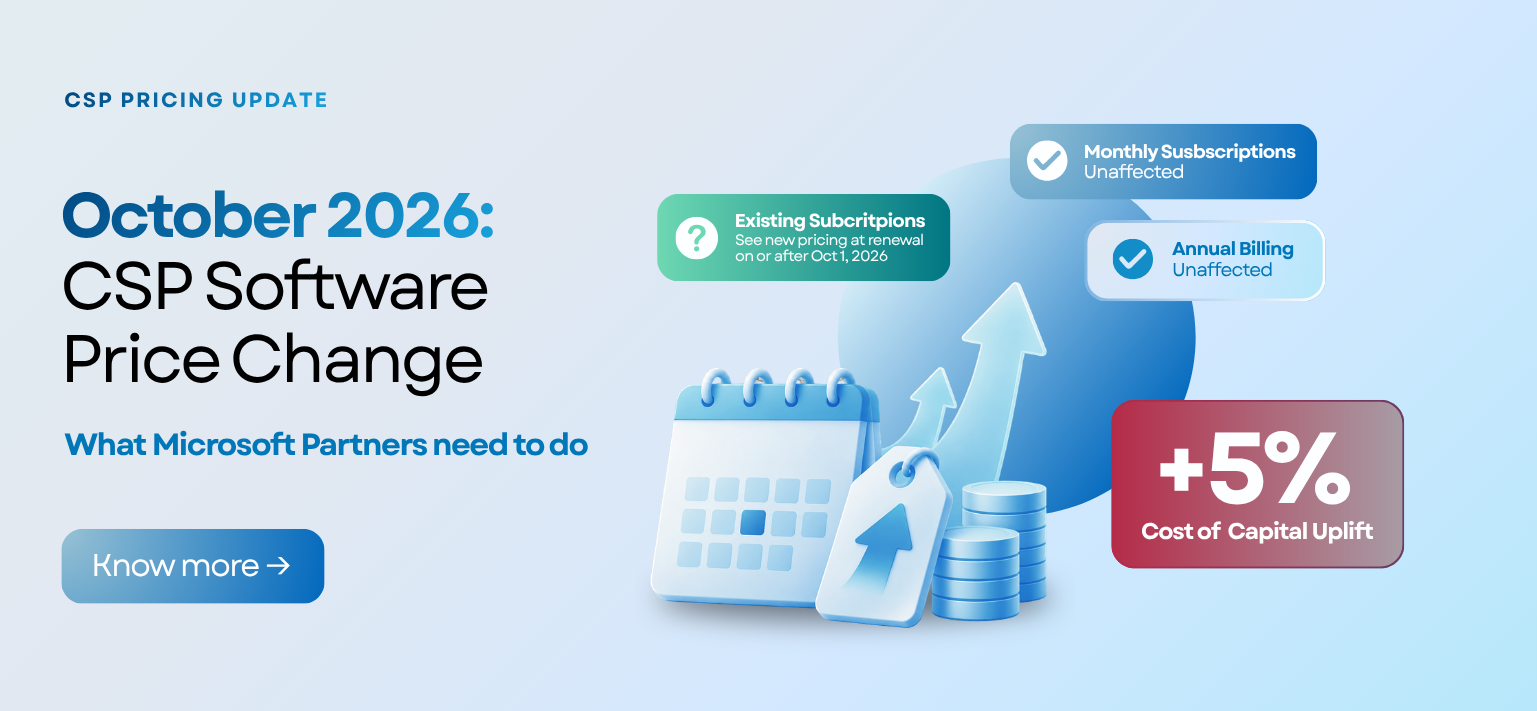

Starting October 1, 2026, Microsoft is changing the pricing treatment for certain CSP software subscriptions.
But there is an important distinction that partners need to understand:
This is not a blanket 5% price increase across Microsoft 365 subscriptions.
Microsoft's announcement specifically applies a 5% cost-of-capital uplift to annual-term CSP software subscriptions that are billed monthly. Microsoft lists products such as SQL Server, Windows Server, Client Access Licenses (CALs), and System Center as examples of affected software subscriptions.
For existing subscriptions, the new pricing applies at renewal on or after October 1, 2026. Microsoft says annual billing and month-to-month subscriptions are not affected by this particular change.
Microsoft also says that no Partner Center or system update is required.
For CSP billing and finance teams, however, that doesn't mean there is nothing to do.
The operational work is identifying which subscriptions are affected, understanding when their pricing changes, evaluating the impact on margin, deciding how customer pricing should be handled, communicating before renewal, and validating billing after the change takes effect.
Here is how CSP partners should prepare.
What is changing on October 1, 2026?
Microsoft announced the following change for the CSP program:
| Effective date | October 1, 2026 |
| Products affected | CSP software subscriptions, including examples such as Windows Server, SQL Server, CALs and System Center |
| Commitment | Annual term |
| Billing plan | Monthly |
| Change | 5% cost-of-capital uplift |
| Existing subscriptions | New pricing applies at renewal on or after October 1 |
| Annual billing | No change from this announcement |
| Month-to-month subscriptions | No change from this announcement |
Microsoft says the purpose is to align pricing treatment across its sales channels while continuing to give customers the flexibility to pay monthly.
There is also an important timing detail.
An existing annual-term software subscription billed monthly does not automatically change price on October 1 if it is already mid-term.
The uplift applies when that subscription renews on or after October 1.
For example:
Subscription A
Renewal: September 28, 2026
→ October 1 pricing change does not apply at that September renewal.
Subscription B
Renewal: October 3, 2026
→ The new pricing treatment applies at renewal.
That makes renewal date, rather than October 1 alone, one of the most important fields for CSP operations teams to review.
What is NOT changing?
This distinction matters. Avoid this framing
"Microsoft is increasing CSP prices by 5% on October 1."
That statement is too broad.
Instead, determine whether the customer's subscriptions actually meet the affected criteria.
The four questions every CSP should ask
For every relevant subscription, determine:
Is this an affected CSP software product?
Microsoft specifically gives examples including SQL Server, Windows Server, Client Access Licenses, and System Center. Do not assume that every Microsoft subscription in your portfolio is affected by this particular announcement.
Is the commitment annual?
The October change specifically applies to annual-term commitments.
Is Microsoft billing the subscription monthly?
The uplift applies to the annual-term/monthly-billed combination. Microsoft says there is no change to annual billing or month-to-month subscriptions under this announcement.
When does the subscription renew?
For existing affected subscriptions, the new pricing applies when they renew on or after October 1, 2026.
Once those four fields are known, partners can begin building the affected subscription population.
Build an affected-subscription list before October 1
A practical review should look something like this:
| Customer | Product | Term | Billing | Renewal | Current cost | Sell price | Action |
|---|---|---|---|---|---|---|---|
| Customer A | Windows Server | Annual | Monthly | Oct. 8 | Review | Review | Pricing review |
| Customer B | SQL Server | Annual | Annual | Nov. 12 | Review | Review | Not affected by this billing uplift |
| Customer C | Software SKU | Annual | Monthly | Sep. 25 | Review | Review | Monitor future renewal |
The exact fields will depend on your systems, but the objective is simple:
Turn a Microsoft announcement into a defined list of customers and subscriptions that require action.
This is where a pricing announcement becomes a revenue-operations problem.
Don't stop at Microsoft cost: calculate the margin impact
Identifying affected subscriptions is only the first step.
The next question is: what happens to the margin on each subscription?
Consider a simplified example. A partner currently has:
| Microsoft cost | $1,000 |
| Customer sell price | $1,150 |
| Gross margin dollars | $150 |
If the applicable Microsoft cost becomes $1,050 after the uplift while the customer sell price remains $1,150:
| New gross margin dollars | $100 |
Nothing necessarily failed operationally. The customer was still provisioned. The invoice may still have been generated. But the economics of the subscription changed.
Across hundreds or thousands of subscriptions, pricing changes that aren't reflected appropriately in customer pricing can create meaningful margin compression. That is why Microsoft pricing changes should not be treated solely as product-catalogue maintenance. They require a commercial review.
Decide how the business will handle the change
Once the affected population is known, Finance and commercial teams need to determine the appropriate response. Depending on customer agreements and commercial strategy, that may mean evaluating whether to:
Absorb the increase — the customer's price stays the same and the partner accepts the margin impact.
Update customer pricing — the customer sell price changes according to the applicable agreement and pricing policy.
Review the billing arrangement — for some customers, the upcoming renewal may also be an appropriate point to review whether their commercial and billing arrangement still makes sense.
The right answer will vary by customer. The important part is that the decision happens before the renewal and subsequent invoice, rather than after Finance discovers a margin discrepancy.
See how Work 365 connects Microsoft cost, customer pricing, renewals and invoicing in one revenue and operations layer.
Book a DemoWhy this becomes difficult at scale
With ten subscriptions, this can be handled manually. With hundreds of customers, multiple Partner Center environments, distributors, currencies, billing arrangements and renewal dates, the problem changes.
A change at the top can affect the economics at the bottom. And this isn't theoretical.
Across Work 365 customer billing conversations, finance and operations teams regularly work through pricing updates, subscription pricing mismatches, contract configurations and reconciliation between provider data and customer invoices.
In one recent reconciliation exercise, a customer identified an approximately $8,000 revenue delta, including a $4,000 double-billing issue.
In another customer discussion involving a move from direct Partner Center transactions to an indirect provider, the team specifically identified margin compression, billing errors and revenue leakage as risks when automated pricing and renewal processes change.
These examples aren't caused specifically by Microsoft's October 2026 uplift. They illustrate the broader operational problem: when provider economics change, CSPs need controls that ensure those changes make their way correctly through pricing, subscriptions and billing.
Microsoft says no system changes are required. So why should Operations care?
Microsoft is correct that partners do not need to make a Partner Center system change for the October update.
But there is an important distinction between:
Microsoft applying the new price correctly and the CSP business responding to that new price correctly.
Microsoft manages the first. The partner still owns the second. That includes:
- identifying affected customers
- reviewing renewal dates
- understanding margin impact
- determining sell-price treatment
- communicating with customers
- ensuring the correct price is used after renewal
- generating the correct customer invoice
- reconciling the result
Microsoft itself specifically recommends communicating the update in advance to customers whose affected subscriptions renew on or after October 1. For CSPs, that requires knowing who those customers are.
A practical October 2026 readiness checklist
Before October 1:
Portfolio
- Identify affected CSP software products
- Identify annual-term subscriptions
- Identify subscriptions billed monthly
- Capture upcoming renewal dates
Commercial
- Review current Microsoft/provider cost
- Review customer sell price
- Calculate expected margin impact
- Determine pricing treatment
- Obtain required commercial approvals
Customer
- Identify customers requiring communication
- Assign account owner
- Explain the change accurately
- Confirm any renewal or commercial decisions
Billing
- Validate product pricing after the change
- Confirm renewed subscription pricing
- Validate customer billing configuration
- Review the first affected invoice
Finance
- Reconcile provider cost against customer billing
- Check expected versus actual margin
- Investigate exceptions before they accumulate
The objective isn't simply to survive October 1. It's to make sure a provider pricing change does not quietly become a margin or billing problem months later.
Where Work 365 fits
Microsoft CSP businesses increasingly operate across a complicated chain of systems and commercial rules.
Work 365 provides a revenue and operations layer for Microsoft partners that brings together areas such as product catalogue management, subscriptions, pricing, billing contracts, renewals, invoicing and reconciliation.
That matters when Microsoft changes something upstream. Instead of treating the October 1 announcement as an isolated price-list event, partners can connect the change to the subscriptions, customers, billing arrangements and downstream financial processes it affects.
Because the real challenge isn't knowing that Microsoft changed a price. It's knowing what that change means for every customer you have to bill.
Work 365 revenue and operations platform
Work 365 connects Microsoft cost, customer subscriptions, pricing rules, billing contracts and reconciliation in one system, so a provider-side change like the October 2026 uplift flows through to the right customers and invoices automatically rather than requiring a manual chase. Explore the CSP billing platform.