Microsoft Changes

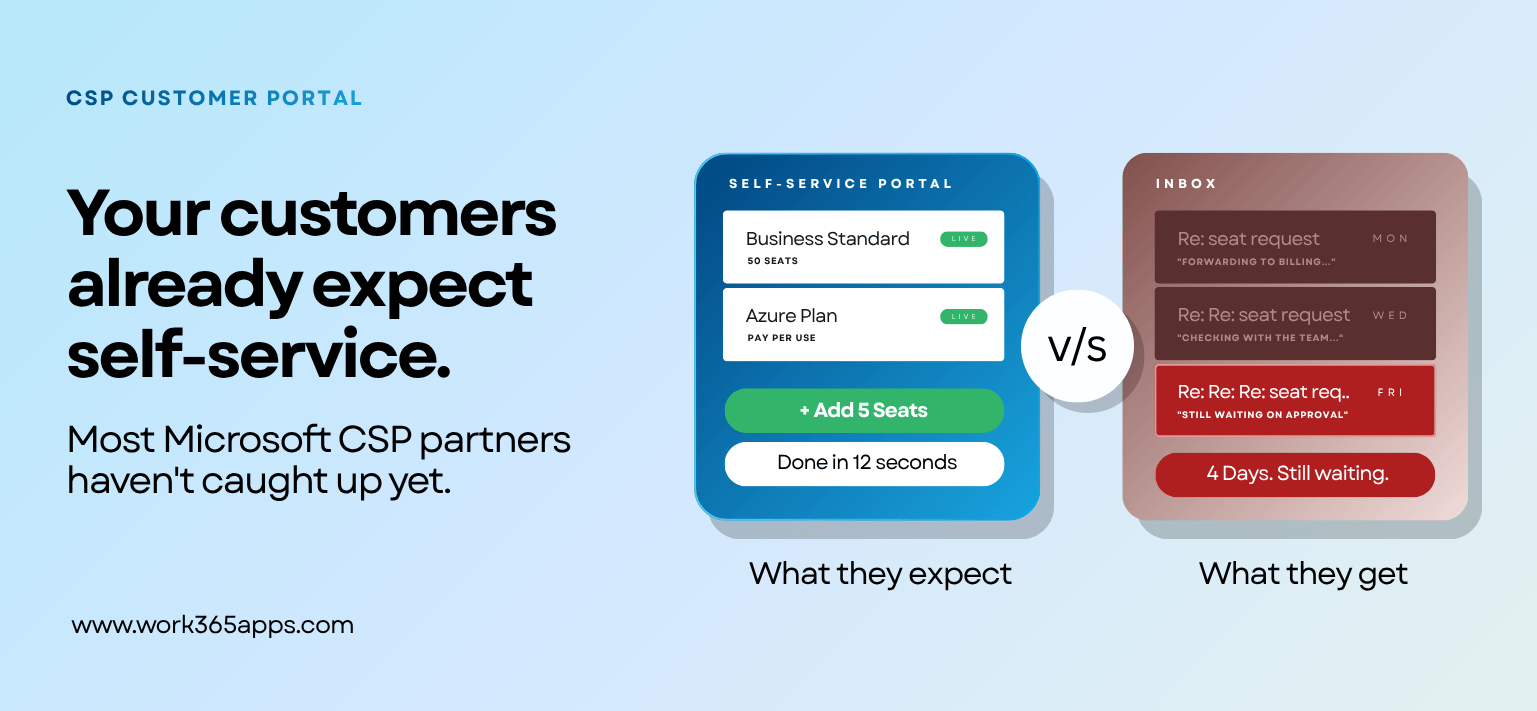
Nobody asked Uber for a "ride request portal."
Customers just assumed it would exist. And when it did, the taxi companies that required a phone call started losing customers not to a better phone call, but to a different model entirely.
Something similar is happening in the Microsoft CSP channel right now. Not dramatically, not overnight. But the expectations your customers carry into every interaction with you have been shaped by years of self-service in every other category of software they use. They renew their own Netflix subscription. They upgrade their own Shopify plan. They add users to their own Slack workspace without calling anyone.
And then they email you to add five Microsoft 365 seats.
Not because they want to. Because they have to.
The gap nobody talks about
Customers rarely complain that your self-service is poor. They absorb the friction silently, factor it into how they perceive you, and at renewal they have a slightly lower opinion of your operation than you realise.
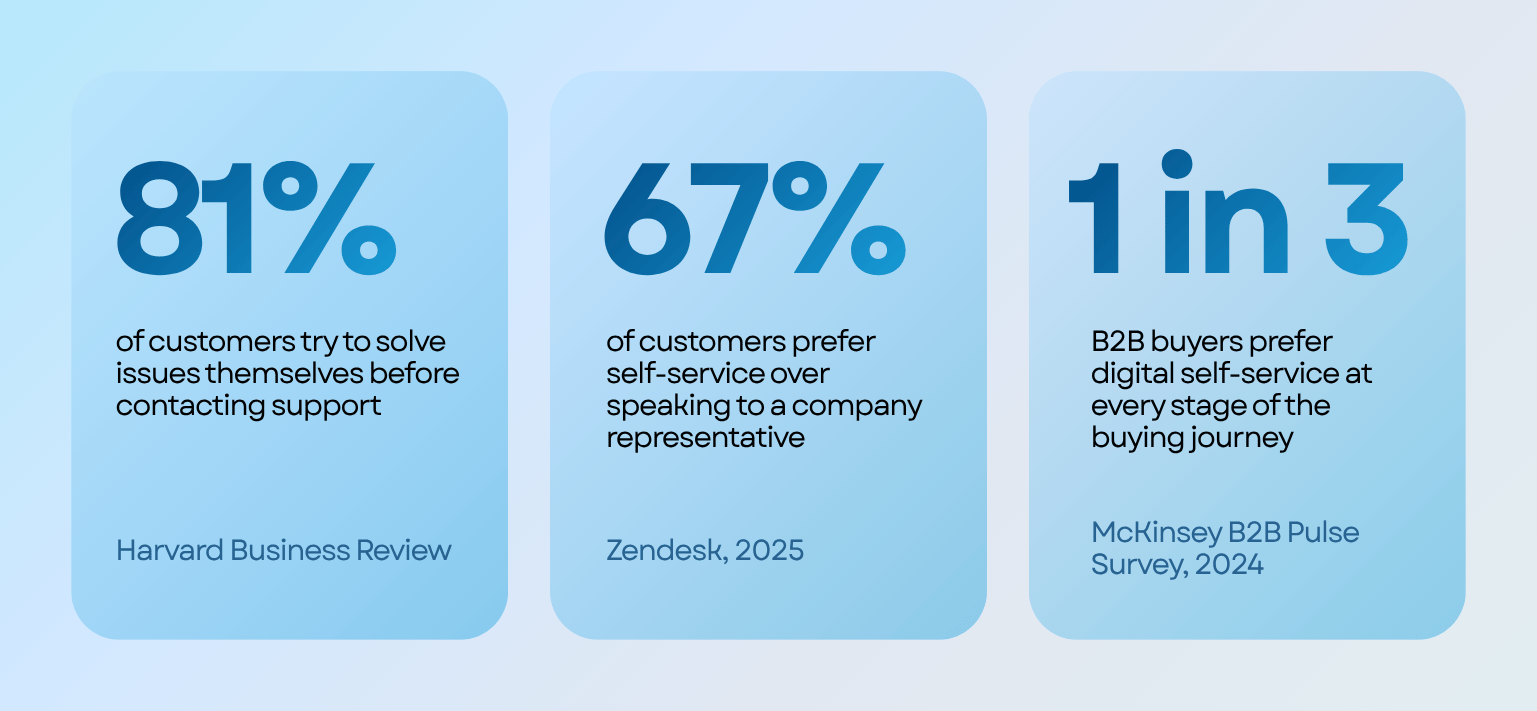
According to Forrester's 2024 CX Index, 56% of customers will not complain after a bad experience, they quietly leave. By the time someone tells you the experience was frustrating, they have usually already decided to go.
This is why the gap does not show up in your support inbox. It shows up in renewal signals. Forrester's research identifies that 68% of churn happens because customers feel "unappreciated" - not because of product failures or pricing, but because the accumulated experience of interacting with a vendor left them feeling like their time was not respected.
A five-day turnaround on a seat change is not a crisis. But it is one more data point in the customer's running assessment of whether doing business with you is worth the friction.
Why it shows up at renewal, not in your inbox
Adding five seats is a routine task. Renewing an annual subscription is a routine task. Downloading an invoice is a routine task. When those tasks require a human intermediary, you are unintentionally communicating that your operation is not built for them.
The problem is that customers process this communication differently depending on how engaged they are with your service overall. Low-engagement customers absorb it as a cost of doing business and move on. High-value, high-engagement customers - the ones you most want to keep - notice it more acutely because their expectations are higher and their time is more constrained.
This is why the gap does not show up in your support inbox. It shows up in renewal signals.
Forrester's research identifies that 68% of churn happens because customers feel "unappreciated" - not because of product failures, not because of pricing, but because the accumulated experience of interacting with a vendor left them feeling like their time and autonomy were not respected. Self-service friction is a direct contributor to that feeling, compounding invisibly over the lifetime of the relationship.
A five-day turnaround on a seat change is not a crisis. But it is one more data point in the customer's running assessment of whether doing business with you is worth the friction. And those data points accumulate.
The partners who feel this first
Not every customer notices the gap equally. Smaller customers with a single Microsoft 365 subscription and minimal changes may never raise it. But two customer profiles will surface it — either directly or through their renewal behaviour.
Enterprise customers expect self-service as an entitlement, not a feature. Their internal IT teams are accustomed to admin consoles with granular control. When they have to email your billing team to change a seat count, they are not thinking "how helpful of them" — they are thinking "why do I need to go through someone for this?" The larger the customer, the more frequently they need to make changes, and the more the friction compounds. These are the customers who build an internal business case to go direct to Microsoft once the $1M TTM threshold becomes achievable.
Fast-growing customers encounter this at exactly the wrong moments — when they are onboarding a new hire cohort, expanding into a new market, or responding to a resourcing decision at speed. If your process requires a two-day turnaround on a seat change, you have inserted yourself as a bottleneck into their growth. They remember that.
McKinsey's data reinforces this: in 2024, B2B buyers' comfort with self-service has "crystallised into a fundamental truth about B2B success." Buyers are comfortable completing transactions of $500,000 or more through self-service channels — up from 59% in 2022 to 73% in 2024. The spend threshold at which customers expect human involvement has moved significantly upward. The implication for CSP partners is clear: the types of interactions that previously justified a human touchpoint are now expected to be digital and self-serve.
What the modern expectation actually looks like
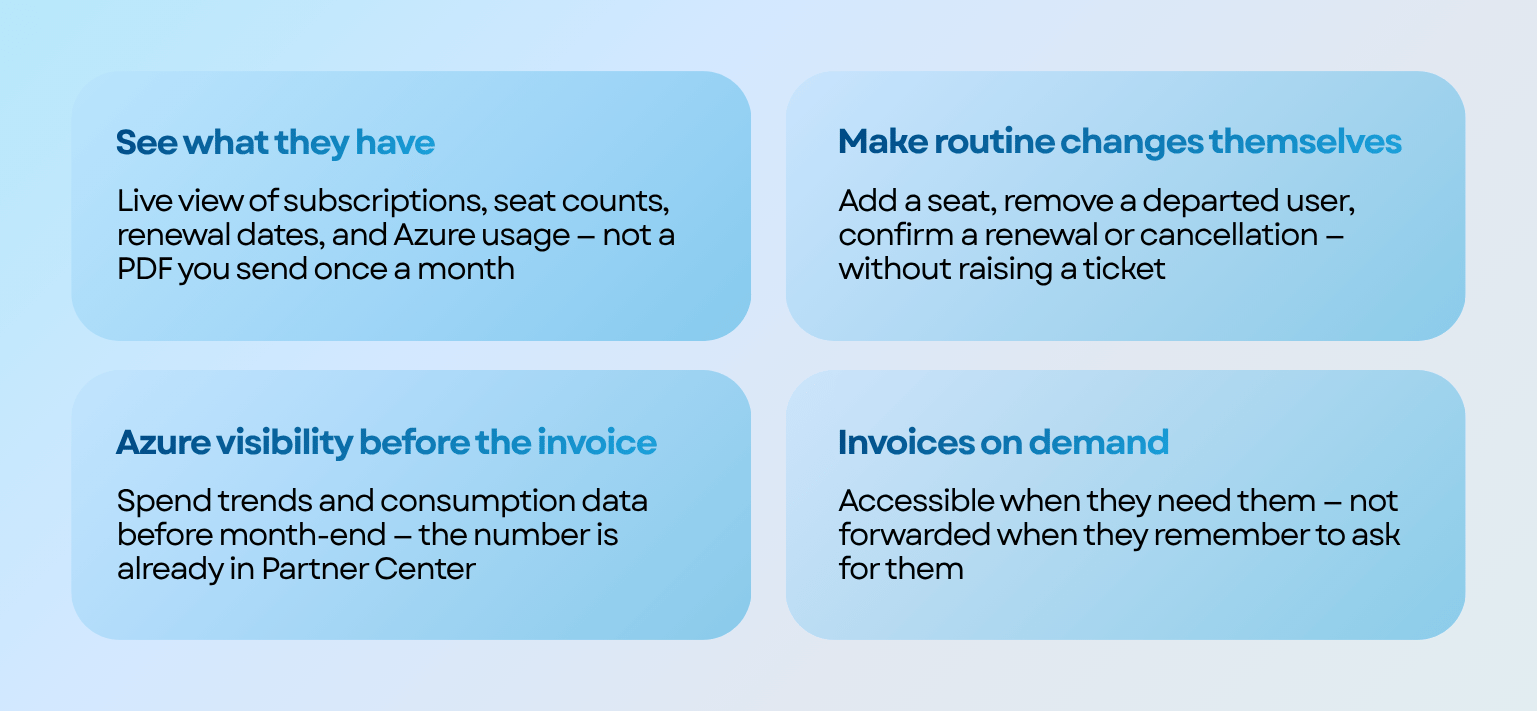
This is not a request for a complex portal with advanced features. The baseline your customers expect is simpler than most partners assume.
None of this is sophisticated. It is the same visibility and control they have in every other SaaS subscription they manage. The expectation has been set elsewhere. You are simply being measured against it.
The data on what happens when that expectation is met is equally clear. Businesses that implement self-service portals report up to a 63% reduction in routine service workload, according to Orases. Customers who experience minimal friction during service interactions are 88% more likely to remain loyal. And according to Forrester, "customer-obsessed" organisations — those that design their operations around ease and customer time — achieve 49% faster profit growth and 51% better customer retention than those that do not.
The inverse is also true. Gartner's research finds that 73% of consumers will switch to a competitor after multiple friction-laden experiences. In a subscription model where switching costs are relatively low, the question is not whether friction causes churn. It is how much friction it takes, and how long the accumulation runs before it surfaces as a cancellation.
The competitive dimension
For most CSP partners, this expectation gap is not yet causing visible churn. But it is creating the conditions for it.
The partners investing in customer self-service right now are not doing it because customers demanded it loudly. They are doing it because they can see where the expectation curve is heading — and they want to be on the right side of it before the gap becomes a selling point for a competitor.
In a market where Microsoft is raising prices, increasing program complexity, and pushing partners toward higher value delivery, the partners who retain and expand their customer base will be the ones who make it easiest to do business with them. Self-service is infrastructure for that. It is not the whole answer — but it is an increasingly non-negotiable part of it.
A 5% improvement in customer retention increases profits by 25 to 95%, according to Bain and Company. In subscription businesses, that arithmetic is especially powerful. The investment required to give customers visibility and control over their own accounts is modest. The compounding value of the retention it protects is not.
The question worth asking your team
Not "do we need a customer portal?" That framing invites a feature discussion that misses the point.
The right question is: how many customer interactions does your team handle every month that the customer could have resolved themselves in under two minutes?
Most CSP operations, if they run that count honestly, land somewhere between thirty and three hundred such interactions per month depending on their book size. That is thirty to three hundred moments where a customer experienced your operation as slower than their expectation — and where your team spent time on something that did not require their judgment.
That is the gap. It is not a technology problem at its core. It is a design problem. How have you designed your customer's experience of managing their Microsoft subscriptions with you?
If the answer is "they email us," it is worth asking whether that design still fits the customers you want to keep.
Work 365 with its Self-service portal gives Microsoft CSP customers real-time self-service for subscriptions, renewals, and billing, built natively on Dataverse.
See how it works: Work 365 Demo - Subscription Management & Billing Automation