
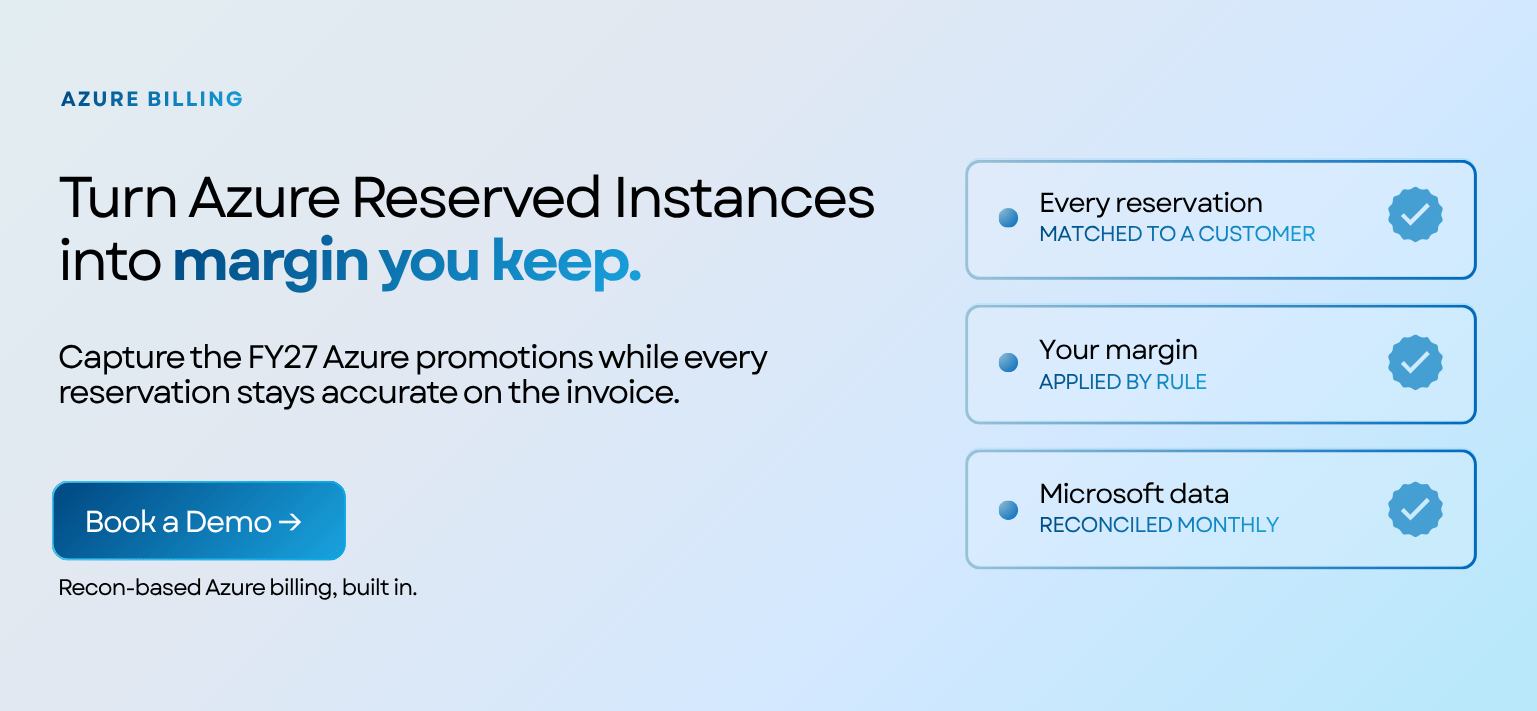

Azure is where a lot of CSP growth is heading, and Microsoft is leaning into it. The FY27 Azure promotions now include percentage-off offers on Reserved Instances and pre-purchase plans, which makes reservations easier than ever to put in front of customers. That is the opportunity. The catch is that a reservation is a commitment you pay for whether or not it is fully used, so the money you make on it depends entirely on how accurately you bill it.
Reserved Instances are one of the most common places revenue quietly slips away. Not through anything dramatic, just through reservations that were never matched to the customer using them, margins applied inconsistently, or invoices that were never reconciled against what Microsoft actually charged. The good news is that all three are solvable, and none of them require heroics at month end.
Here is where the money moves, and where it leaks.
Reservation cost
Microsoft charges you for the commitment, upfront or monthly, discounted against pay-as-you-go.
Allocation and margin
Match each reservation to the customer using it and apply your pricing rule. This is where most leakage starts.
Reconciled invoice
Reconcile against Microsoft's data every cycle so the amount billed matches the amount charged.
Five moves for clean Reserved Instance billing
These build on each other. Get the first two right and most of the leakage disappears before you reach reconciliation.
Start from the reservation, not the invoice
Know exactly what you bought: the term, whether it is billed upfront or monthly, and the scope it applies to. A reservation billed as if it were ordinary pay-as-you-go usage is the fastest way to misprice it. Treat it as its own line with its own economics.
Match every reservation to the customer using it
Allocation is where the margin is won or lost. A reservation that is not tied to the customer consuming it becomes a cost you carry and usage you never bill for. Assign each one to the right customer so the commitment you paid for is the commitment you invoice.
Apply your margin with a consistent rule
Reservations do not behave like on-demand usage, so a one-off manual markup invites mistakes. Set the pricing rule once, apply it automatically, and your margin holds across every reservation and every cycle without someone re-checking the math.
Reconcile against Microsoft's data every cycle
Recon-based Azure billing compares what you invoiced customers against Microsoft's reconciliation data, so any gap or double-charge shows up before it reaches the customer. This is the difference between finding a discrepancy in your own review and hearing about it from a client. Our recon-based Azure usage billing is built for exactly this.
Automate the sync so it holds
Reservations change: they get purchased, scoped, and renewed. A real time Microsoft Partner Center sync keeps those changes reflected in provisioning and billing without polling delays or manual re-keying, so accuracy is the default state rather than a monthly scramble.
With FY27 Azure consumptive promotions extending to Reserved Instances and pre-purchase plans, more of your customers will move onto reservations this year. Every reservation you add is margin if it is billed accurately, and margin left on the table if it is not.
The engine behind it
Work 365 recon-based Azure billing
Work 365, revenue and operations platform for Microsoft partners: handles Reserved Instances as their own billing type, allocates them to the right customer, applies your margin by rule, and reconciles against Microsoft's data every cycle. A real time Partner Center sync keeps it accurate as reservations change, and with Work 365 ENGEN your customers can see their own usage and reservations while your team keeps the rules underneath. See how customer self-service fits in.
The FY27 Azure promotions are an invitation to grow your reservation base. Bill those reservations cleanly, and that growth shows up where it should: in your margin.