
Ask a CSP finance lead where their margin goes, and the honest answer is usually a shrug followed by a spreadsheet. The instinct is to look for a mistake: a mistyped quantity, a missed cancellation, a customer billed at the wrong rate. Sometimes that is what it is. More often, the money slips through a gap that no one entered by hand.
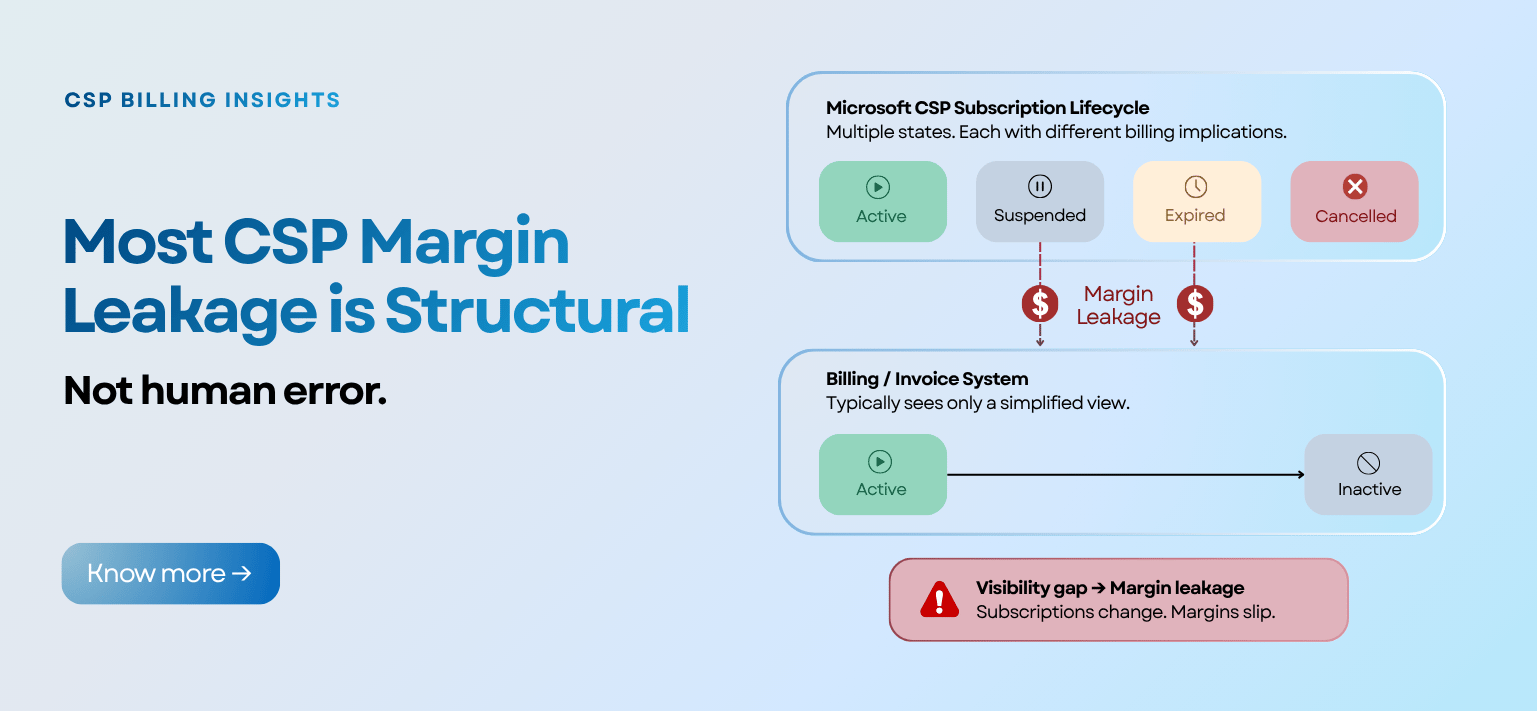
That gap sits between how Microsoft models a subscription and how most billing runs on it. Microsoft new commerce subscriptions move through six lifecycle states. Most billing views, and most PSA agreements, think in two: active or inactive. Everything that falls between those two pictures is where recurring revenue quietly leaks, and because nobody typed it wrong, month-end checks rarely catch it.
The six states, and the two that catch people out
Every new commerce subscription is always in one of six states. The two worth memorising are Suspended and Expired, because both behave in ways a simple active or inactive toggle gets wrong.
| State | What it means | Are you billed? |
|---|---|---|
| Active | The normal state. Customers use the service, you manage the subscription. | Yes |
| Suspended | You have paused service, usually for non-payment. The customer loses access, but their admins keep data access. | Yes, still billed |
| Expired | Auto-renew was off and the term ended. Since 4 May 2026, eligible subscriptions move into a paid Extended Service Term rather than a free grace window. | Yes, under EST |
| Disabled | The term has ended without renewal. Users are locked out, admins can still reach data, and the subscription is heading toward deletion. | Depends on term |
| Cancelled | Cancelled inside the seven-day window. After that window, new commerce subscriptions cannot be cancelled. | Stops |
| Deleted | The subscription is removed once its lifecycle completes. | No |
Source: Microsoft Partner Center subscription lifecycle documentation. EST enforcement began 4 May 2026.
The mechanics in one line: a suspended subscription keeps billing you, and expired or disabled ones can sit off your main Partner Center view. Watertight billing is simply closing that gap before the invoice goes out.
Why the gap is structural
None of this is carelessness. It is a mismatch between a rich six-state model and the single switch most tools use to represent it. A PSA agreement is either billing or it is not. Partner Center itself surfaces active subscriptions front and centre, while non-active states are easy to miss unless you go looking. So the subscription that looks active in your agreement list on invoice day may already be sitting in a state that costs you money with no matching revenue behind it.
Where it shows up
- Suspended seats you are still paying for. You suspend a customer for non-payment, the customer stops seeing the service, and Microsoft keeps charging you for those seats until the subscription is reactivated or its term ends.
- Expirations that quietly become a cost. With the free grace window gone, an expired subscription that no one actioned now carries an Extended Service Term charge rather than winding down for nothing.
- Mid-cycle pricing and SKU changes. When Microsoft adjusts a price or restructures a bundle mid-term, an agreement that was not repriced bills the customer on yesterday's numbers while your cost has already moved.
The pattern that hurts most is the double loss. On invoice day the billing admin pulls the agreement list, sees a set of subscriptions that looked active last cycle, and sends the invoices. A few days later a customer queries a credit for a service that was suspended last week. You issue the credit, and only then does the reconciliation land: Microsoft was billing you the whole time. You have refunded the revenue and absorbed the cost. Nobody made an error. The workflow simply could not see the state change in time.
See how one finance team closed the gap
TSG standardised billing across 125 vendors on Work 365 and moved reconciliation from a month-end scramble to a continuous, exception-driven process.
Read the TSG StoryThe fix is visibility, not vigilance
You cannot spreadsheet your way out of a structural gap, and asking a billing admin to be more careful does not change what the tools can see. The answer is to make reconciliation continuous and exception-driven, so every state change and every mid-cycle pricing change is flagged before the invoice goes out, not discovered after it has been paid.
Reconciliation-first billing on Work 365
Work 365 is the revenue and operations platform for Microsoft CSP partners, built natively on the Microsoft Power Platform. Because the catalogue, provisioning, subscription management, self-service through ENGEN, and billing all run through one layer, a suspension, an expiry, or a price change is reflected in what you bill automatically. What you charge the customer and what Microsoft charges you stay in agreement, which is the whole point of watertight billing. See how customer self-service fits in.
“Watertight billing. That nervousness around revenue leakage has gone away.”
Paula McTeer, Head of Finance Operations, TSG
Since standardising on Work 365, TSG has grown to over 15,000 subscriptions and around 1,400 clients while running a leaner finance operation, managing 125 vendors through one platform.
The same discipline is what lets partners grow without adding headcount. Infinity Group reached 100% billing coverage with 60% faster billing turnaround and 75% less manual billing effort after standardising on Work 365, saving over £1M annually. When the operations layer keeps every state and price straight, scaling from tens of customers to hundreds stops being the moment billing breaks and becomes the moment it proves itself.