Microsoft Changes
Microsoft 365 July 2026 Price Increase: CSP Partner Guide

Amar Paatil
Microsoft 365 July 2026 Price Increase: What CSP Partners Need to Do Now
10:22
Microsoft is raising Microsoft 365 prices on July 1, 2026 across Business, Enterprise, and Frontline plans with increases ranging from 5% to 43% depending on SKU. For CSP partners, this is the most commercially significant deadline of the year. Customers who renew before July 1 lock in current pricing for the full term. Every customer renewing after July 1 pays the new rates.
This guide covers every affected SKU, what Microsoft is adding to justify the increase, and the actions CSP partners need to take before the deadline.
Which Microsoft 365 SKUs are changing on July 1
Microsoft announced the pricing update in December 2025 — the third commercial price increase since Office 365 launched in 2011. The last was March 2022. Increases take effect across all purchasing channels: CSP, Enterprise Agreement, and direct web.
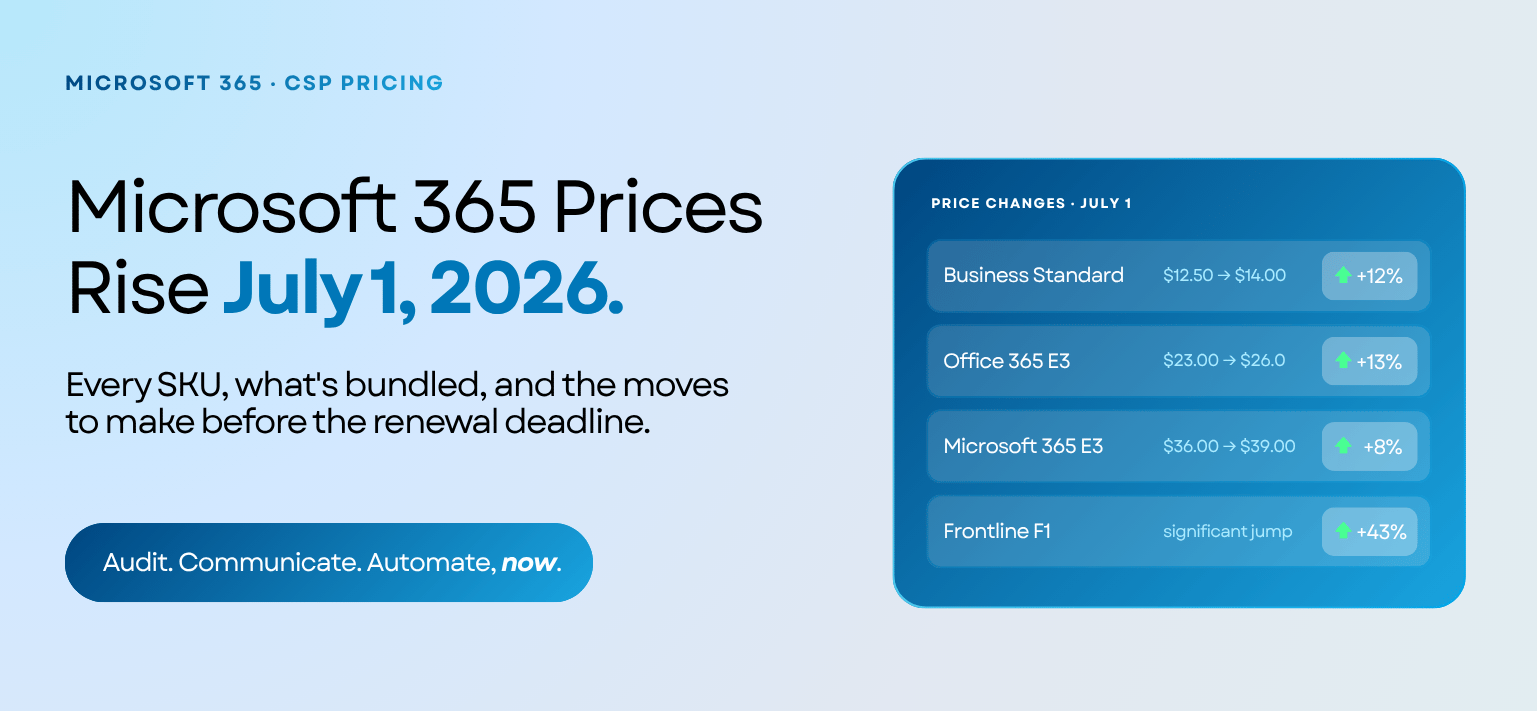
| Plan | Current price | New price (July 1) | Change |
|---|---|---|---|
| Microsoft 365 Business Basic | $6.00/user/mo | $7.00/user/mo | +17% |
| Microsoft 365 Business Standard | $12.50/user/mo | $14.00/user/mo | +12% |
| Microsoft 365 Business Premium | $22.00/user/mo | $22.00/user/mo | No change |
| Office 365 E1 | $10.00/user/mo | $10.00/user/mo | No change |
| Office 365 E3 | $23.00/user/mo | $26.00/user/mo | +13% |
| Microsoft 365 E3 | $36.00/user/mo | $39.00/user/mo | +8% |
| Microsoft 365 E5 | $57.00/user/mo | $60.00/user/mo | +5% |
| Microsoft 365 F1 | lower base | significant increase | up to +43% |
| Microsoft 365 F3 | lower base | significant increase | up to +25% |
Three things stand out in this table for CSP partners specifically.
Business Standard is the volume SKU most affected. A 12% increase on a 50-seat deployment is $900 more per year from a single renewal. Multiply across a portfolio of 50 SMB customers and the number becomes a meaningful revenue and conversation management challenge.
Business Premium holds flat — by design. Microsoft is deliberately narrowing the gap between Standard ($14) and Premium ($22 — unchanged). The upsell narrative writes itself. This is not accidental.
Frontline SKUs face the largest percentage increases. Partners serving retail, healthcare, manufacturing, or logistics customers with large deskless workforces will feel this most acutely. F1 increases of up to 43% warrant proactive customer communication, not a reactive invoice.
What Microsoft is bundling into each tier
Microsoft has framed this as a value update, not just a price hike. New capabilities roll into each tier between June and August 2026. No customer action is required to receive them — features activate automatically with 30-day notice via Message Center.
Every plan receives Copilot Chat enhancements: inbox and calendar awareness in Outlook, access to Word, Excel, and PowerPoint agents, plus Copilot Chat Analytics for admins.
Office 365 E3 and Microsoft 365 E3 gain Microsoft Defender for Office 365 Plan 1. This adds Safe Links (URL scanning at time of click), Safe Attachments (sandboxing for email attachments), and attack surface reduction capabilities. For E3 customers currently purchasing Defender separately as an add-on, this bundling changes the cost equation — the price increase may be neutral or even positive once you run the numbers.
Microsoft 365 E3 and E5 gain Intune Remote Help, Intune Advanced Analytics, and Intune Plan 2. These were previously standalone add-ons. Partners whose customers pay for Intune add-ons separately should model the total cost now. The bundling may offset the list price increase entirely.
Microsoft 365 E5 gets everything above plus Intune Endpoint Privilege Management, Enterprise Application Management, Microsoft Cloud PKI, and — the headline feature — Security Copilot for all E5 tenants.
The honest assessment for CSP partners: customers who already buy Defender P1, Intune add-ons, or security tooling separately may see neutral or reduced total spend after bundling. Customers who weren't using those features are paying for capabilities they may not activate. This distinction determines how you position the renewal — do the licence audit before the customer conversation.
What this means for your CSP renewal pipeline
The July 1 deadline creates three distinct customer segments in your portfolio.
Customers renewing before July 1 can lock in current pricing for the full renewal term — one year or three years. The maths is straightforward. A 100-seat Business Standard customer renewing annually before July 1 saves $1,800 over the next 12 months compared to renewing in August. Three-year NCE commitments extend this further, with Microsoft currently offering 10% discounts on E3 (3-year) and 15% on E5 (annual) through June 30.
Customers renewing after July 1 move to new pricing automatically at their next renewal date. No action is required from them — but the conversation still needs to happen now. Partners who proactively explain the change and model the cost impact before the invoice arrives build trust. Partners who show up with a higher bill without context lose accounts.
Customers who could upgrade represent the highest-margin opportunity in this moment. Microsoft is explicitly directing partners to use this pricing event to drive upsells to E3, E5, and Copilot Business. The closing price gaps make those conversations more commercially compelling than at any point since 2022.
The operational problem most CSP partners will hit
The real challenge is not the pricing itself — it is managing renewal conversations at scale across a full portfolio simultaneously. Partners without real-time visibility into which customers renew when, on which SKUs, will spend June firefighting rather than selling.
For partners using Work 365, the renewal pipeline is visible by customer, SKU, seat count, and renewal date — filterable to identify every customer renewing before July 1 and build outreach sequences without manual spreadsheet work. The six-week window becomes a systematic commercial motion.
For partners without automated renewal tracking, the minimum viable approach is this: pull your full customer list from Partner Center this week, sort by renewal date, and tag everyone renewing before June 30 as an immediate priority. That list is your June action plan.
The three upsell conversations the pricing table creates
1. Business Standard → Business Premium
The price gap narrows from $9.50/user to $8.00/user after July 1. Business Premium ($22, unchanged) includes Intune, Entra ID Premium P1, and advanced security features. For customers in regulated industries, remote-first environments, or those already purchasing Intune separately, the upgrade conversation is now easier to land than it has been since 2022.
2. E3 → E5 for security-focused customers
Security Copilot bundling into E5 is the most significant E5 value addition in years. Customers with active security operations teams who were previously evaluating Security Copilot as a separate purchase now have a clear cost-benefit case for E5. Model the current add-on spend against the $3/user/month E5 increase — for many customers, the maths favours upgrading.
3. Annual → 3-year NCE before June 30
Moving customers to 3-year NCE commitments before July 1 locks in current pricing through 2029 and qualifies for Microsoft's current promotional discounts. This is a meaningful saving at enterprise scale: a 500-seat E3 customer on 3-year NCE saves approximately $93,600 annually versus list price, according to partner modelling data.
As a CSP Partner, what's your plan of action?
1. Pull your renewal calendar. Filter all active subscriptions by renewal date in Partner Center or your PSA tool. Tag every customer renewing before September 30 as a priority conversation — not just June 30. Customers renewing in Q3 need to know this is coming even if they can't act before July 1.
2. Run a licence audit for your top 20 accounts. Identify Defender P1, Intune add-ons, and standalone security tooling being purchased separately. For those accounts, model the bundling impact. A customer spending $4/user on Defender P1 separately on E3 may find the E3 price increase costs less than their current add-on spend. That is a strong, defensible renewal narrative.
3. Automate renewal tracking if you haven't already. July is not the last deadline. EST enforcement hit in May. July brings pricing. E7 is coming. These events compound. Partners who can see their renewal pipeline in real time — filtered by SKU, renewal date, and seat count — will systematically outperform those who manage this in spreadsheets.
The bottom line
The July 1 deadline is in six weeks. Every customer in your portfolio is affected at their next renewal.
The data makes the case simply: renewing before July 1 saves real money for customers, and the partner who shows them the numbers builds a relationship. The partner who shows up with a higher invoice without context loses one.
Managing renewals manually across hundreds of subscriptions? Work 365 is a CSP Billing Management Platform that gives CSP partners real-time visibility into the full renewal pipeline — by customer, SKU, seat count, and renewal date — so moments like this become a systematic commercial motion rather than a reactive scramble.
Book a 20-minute walkthrough →
When does the Microsoft 365 price increase take effect?
July 1, 2026. Existing customers on commercial Microsoft 365 subscriptions stay at current pricing until their next renewal after that date. New customers and renewing customers after July 1 pay the new rates.
Can customers lock in current pricing before July 1?
Yes. Any customer who renews or upgrades their subscription before July 1, 2026 can lock in current pricing for the full term of that renewal — whether one year or three years.
Which Microsoft 365 plans are not increasing in price?
Microsoft 365 Business Premium ($22/user/month) and Office 365 E1 ($10/user/month) hold flat. Standalone Microsoft Teams and standalone Microsoft 365 Copilot SKUs are also not affected by this pricing update.
Does the price increase apply to CSP and Enterprise Agreement customers?
Yes. The July 2026 pricing update applies across all purchasing channels: CSP, Enterprise Agreement, and direct web. Existing customers see the new prices at their next renewal after July 1, regardless of how they buy.
What new features are customers getting in exchange for the price increase?
All plans get Copilot Chat enhancements. E3 customers get Microsoft Defender for Office 365 Plan 1 and Intune improvements. E5 customers get Security Copilot.
What happens to customers with mid-term subscriptions?
Mid-term subscriptions stay at current pricing until their next renewal after July 1. If a customer is mid-way through an annual NCE agreement renewing in September 2026, they keep current pricing until September and then renew at the new rates.
As a CSP partner, what is the most important action to take right now?
Pull your renewal calendar and identify every customer renewing before June 30. Those customers can lock in current pricing with a renewal today.