Microsoft Changes

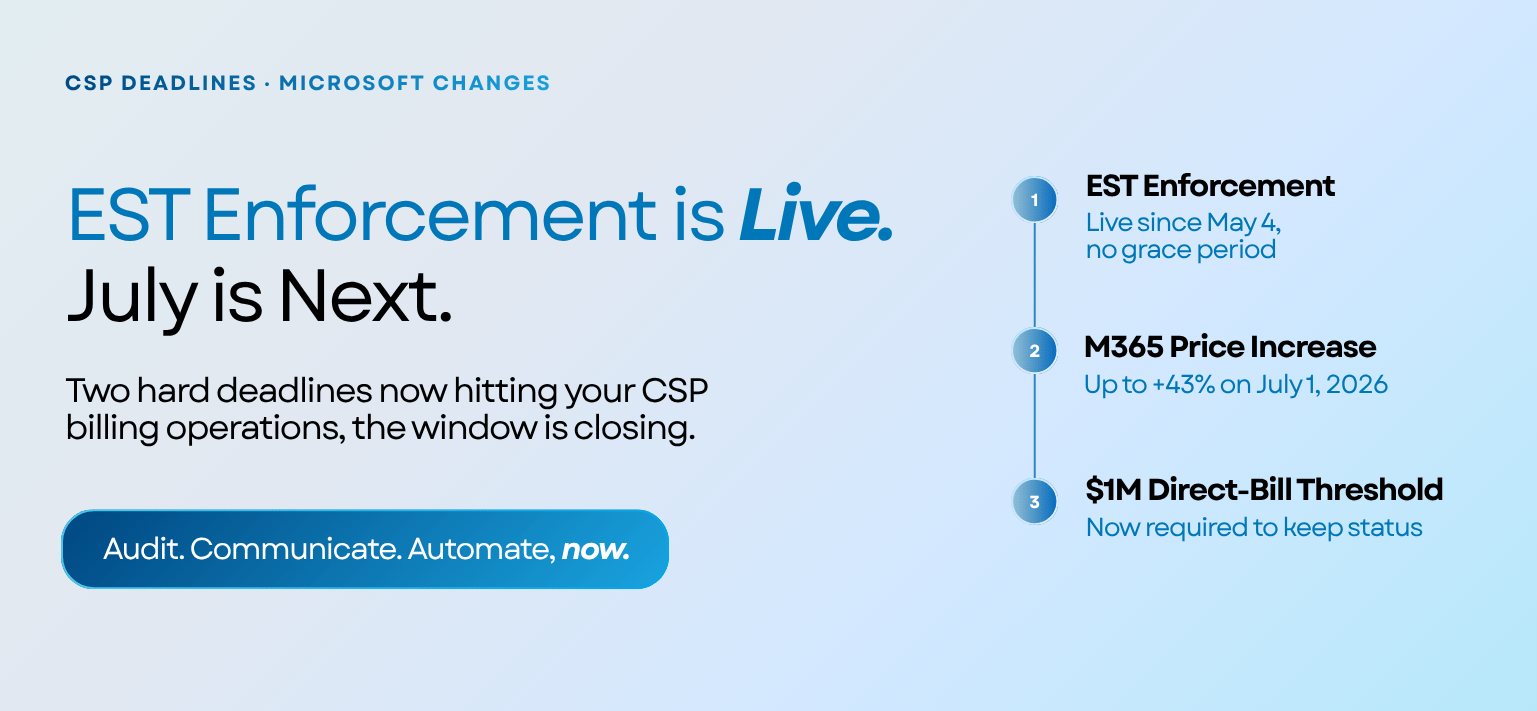
Two hard deadlines: Extended Service Term (EST) full enforcement began May 4. Microsoft 365 commercial pricing increases 5–33% on July 1. Both hit your billing operations directly — and the window to act is closing.
May is turning into one of the busiest months in recent memory for Microsoft CSP partners. New enforcement rules, a meaningful price increase, and a raised bar for direct-bill status - all landing within weeks of each other. This post cuts through the noise and gives you a clear picture of what's changing, what it means for your operations, and how partners are responding.
What's changing now?
What Is Microsoft CSP EST Enforcement and Why Does It Matter Now?
Since April 1, 2026, Microsoft removed the free grace period for CSP subscriptions at end of term. From May 4, any subscription purchased on or after April 1, 2025 that reaches end of term with auto-renew turned off will automatically move into an Extended Service Term — a paid continuation at the existing contract rate, with no buffer and no warning to the customer.
For partners managing hundreds of subscriptions manually, this creates a real and immediate risk: customers entering EST periods they didn't ask for, billing exceptions that are hard to trace, and reconciliation headaches that show up weeks later.
Three things to action before your next renewal cycle
- Run the EST audit in Partner Center. Microsoft now provides an EST download feature — export it, filter for subscriptions with auto-renew off, and triage by renewal date.
- Start proactive renewal conversations now. Customers shouldn't discover EST on their invoice. A short proactive outreach — especially to any account renewing before September — protects the relationship and reduces disputes.
- Make sure your billing platform flags EST automatically. Manual tracking across hundreds of subscriptions isn't reliable. If your system doesn't surface EST status and renewal dates in a single view, you're flying blind.
Work 365 surfaces EST status, renewal dates, and auto-renew flags directly within your billing workflow — so your team sees the risk before it becomes a billing exception, not after the customer notices it on their invoice.

Mark the calendar
The July 2026 M365 Price Increase: How to Protect Your Customers' Pricing Before the Deadline
Microsoft is raising M365 commercial plan pricing between 5% and 33% effective July 1, depending on the tier — the third significant price increase since Office 365 launched. Annual commitments locked in before July 1 will hold current pricing for the full 12-month term, making this a genuine, time-limited conversation to have with every customer.
"Partners who can identify which customers are mid-term, which are up for renewal, and which are on monthly billing — and reach them proactively — will protect revenue. Partners who can't surface this data quickly will be reacting."
For CSP partners, the opportunity is straightforward: any customer renewing between now and December 2026 should hear from you before July 1. The math is simple — a 50-seat Business Standard renewal locks in roughly $450 in annual savings. For a larger enterprise on E3, that runs into thousands. That's a conversation customers appreciate, and one that reinforces why they buy through a partner rather than direct.
The conversation to have with every renewing customer right now
"Your current annual pricing locks in until [renewal date]. If you renew before July 1, you hold that rate for another 12 months — here's what that saves you." That conversation requires knowing each customer's renewal date, their current SKU mix, and their seat count — instantly, not after a manual export.
Program change
The $1M Direct-Bill Threshold: Why Billing Accuracy Is Now a Compliance Issue
Microsoft raised the minimum trailing 12-month CSP billed revenue for direct-bill partners to $1M at the Partner Global Account level — up from approximately $300K. Partners near the threshold need clean, auditable revenue reporting to maintain their status. The question isn't just whether you hit the number — it's whether your platform can produce the reconciliation data to prove it, and whether your billing is accurate enough that you're not leaving revenue uncounted.
2–3% Average revenue leakage recovered by GadellNet within 3 months of moving to Work 365.
Revenue that was being billed inaccurately or missed entirely — the kind of leakage that becomes a direct-bill status problem at scale.
How Work 365 Helps Microsoft CSP Partners Manage EST, Renewals, and Billing Automatically
Rather than a feature list, here's what conversations with Work 365 partners look like in May 2026:
Automating EST and renewal management at scale
Partners with 200+ customers can't manually track renewal dates across Partner Center tabs. Work 365 pulls subscription status, EST flags, and renewal dates into a single view — with workflow triggers for proactive customer outreach before the window closes.
Running Azure billing without reconciliation surprises
Azure consumption billing on a monthly close is hard to get right manually. Work 365's latest updates introduced reconciliation-first Azure billing — matching usage to invoice before it goes to the customer, not after a dispute opens.
Giving customers a self-service layer that reduces tickets
ENGEN — Work 365's customer-facing engine — lets end customers view subscriptions, request seat changes, and see upcoming renewals without raising a ticket. For a growing partner, this is the difference between needing a billing team of three and needing one.
If EST transitions, the price increase conversation, or billing accuracy resonates - we'd like to show you how other partners are handling it. No pitch deck. Just a practical look at your current setup.