Microsoft Changes

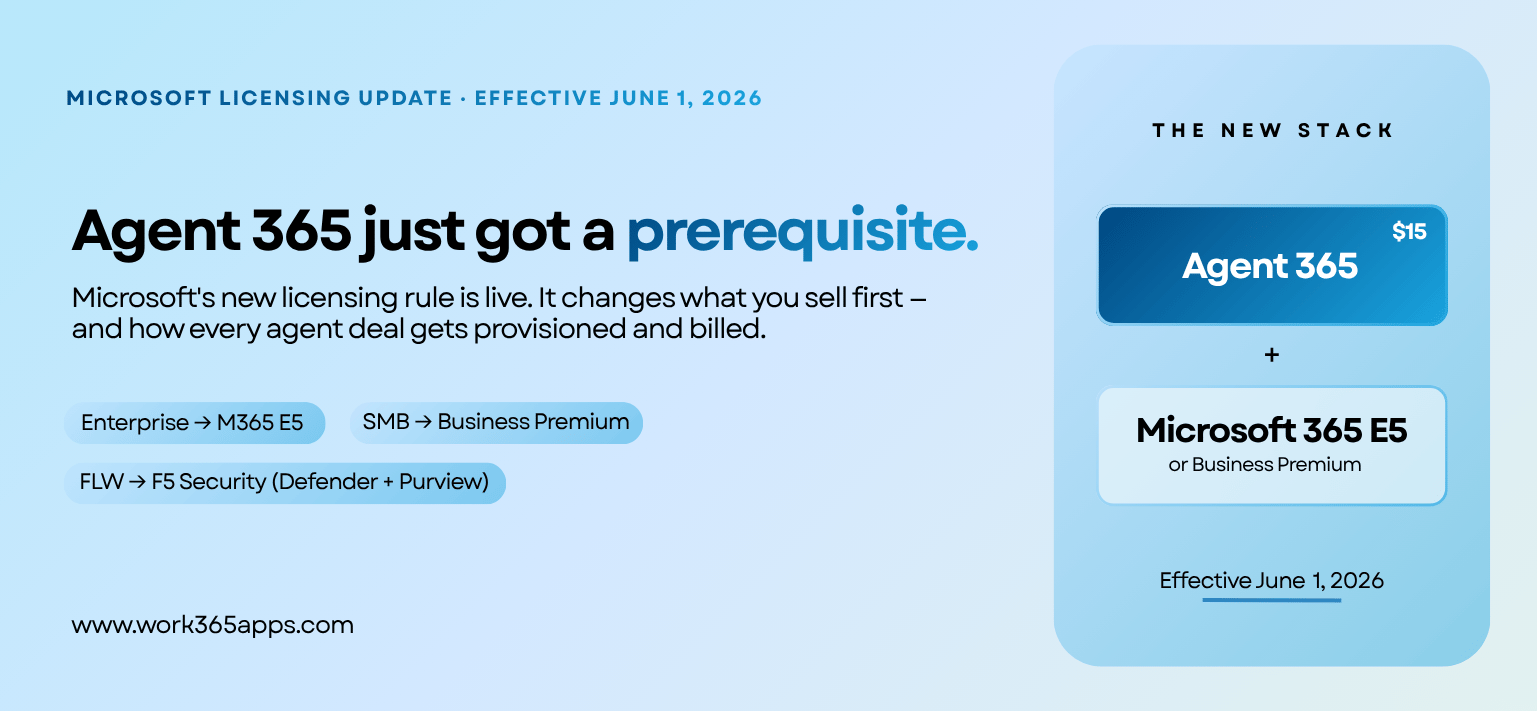
Effective June 1, 2026, Microsoft Agent 365 can no longer be sold as a standalone line. Here's what the new prerequisite means operationally, and why the partners who handle it cleanly will win the agent opportunity.
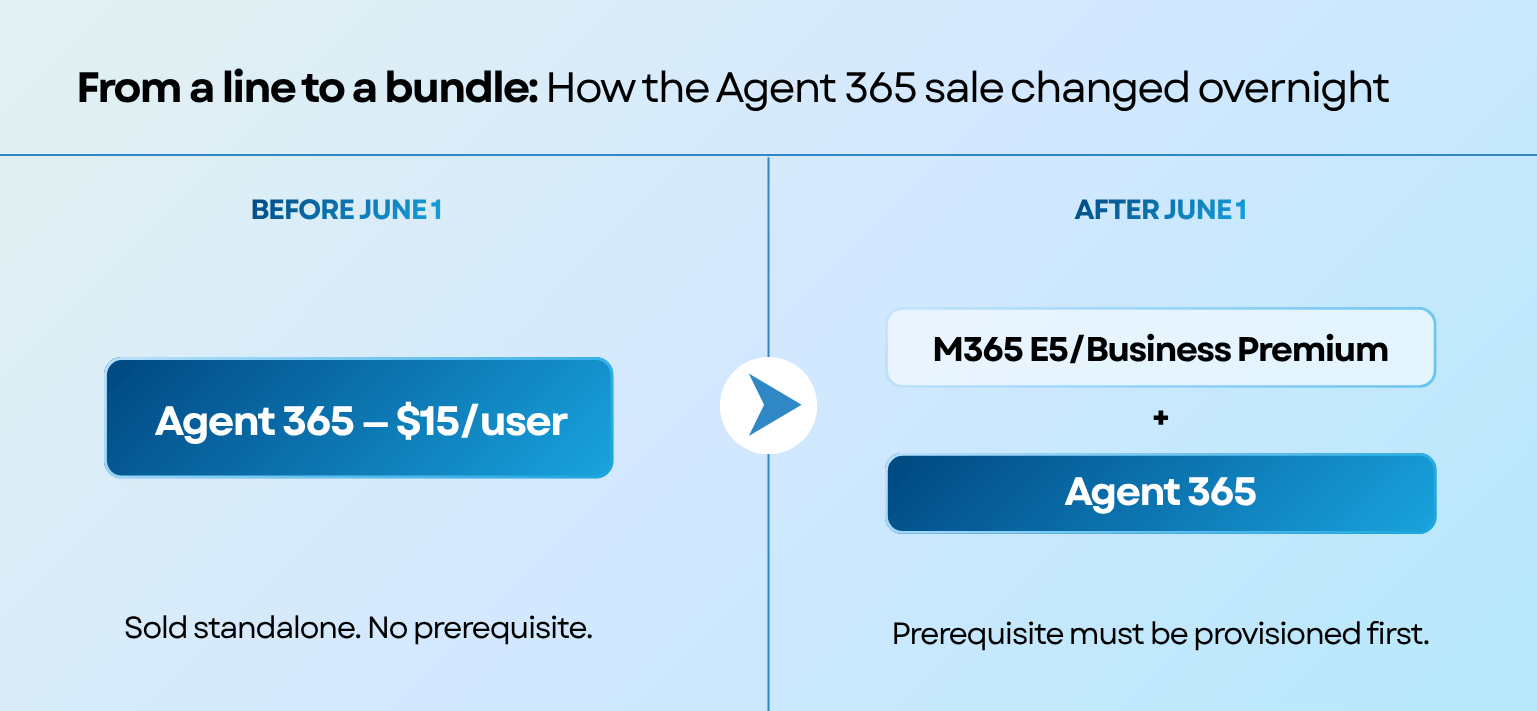
Microsoft Agent 365 launched in May as a $15-per-user governance and control layer for AI agents, with no hard licensing prerequisite attached. That changed on June 1.
Agent 365 now sits on top of a mandated security and identity foundation. The agent layer depends on advanced data protection, threat detection, device policy, and identity controls — and Microsoft has decided those have to be in place before Agent 365 capabilities will switch on. Sold without them, an Agent 365 deployment simply won't deliver its core functionality.
For your customers, that's a licensing conversation. For you, it's an operational one.
What actually changed
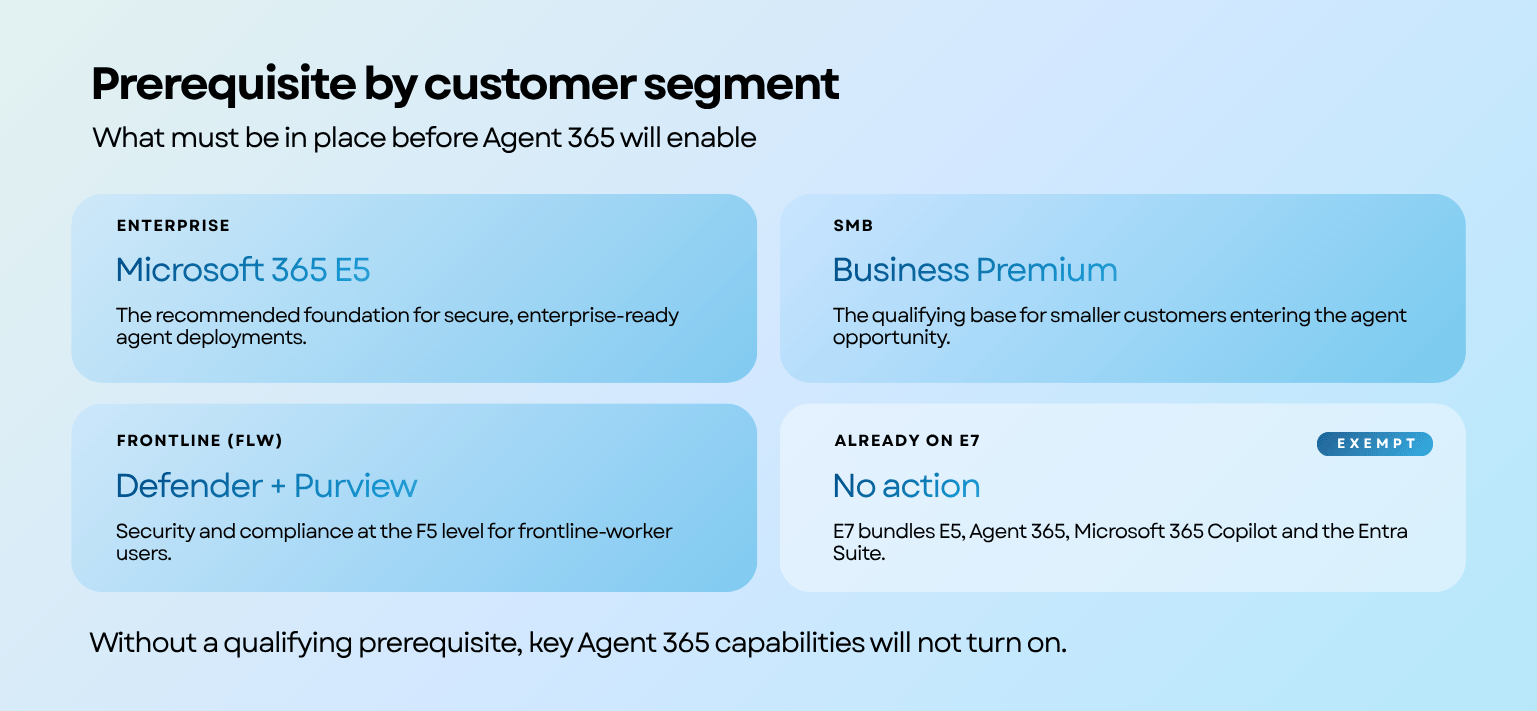 The prerequisite varies by customer segment:
- Enterprise customers need Microsoft 365 E5.
- SMB customers need Microsoft 365 Business Premium.
- Frontline (FLW) users need Defender and Purview at the F5 level.
- E7 customers are unaffected — the E7 bundle already includes E5, Agent 365, Microsoft 365 Copilot, and the Entra Suite, so the foundation is built in.
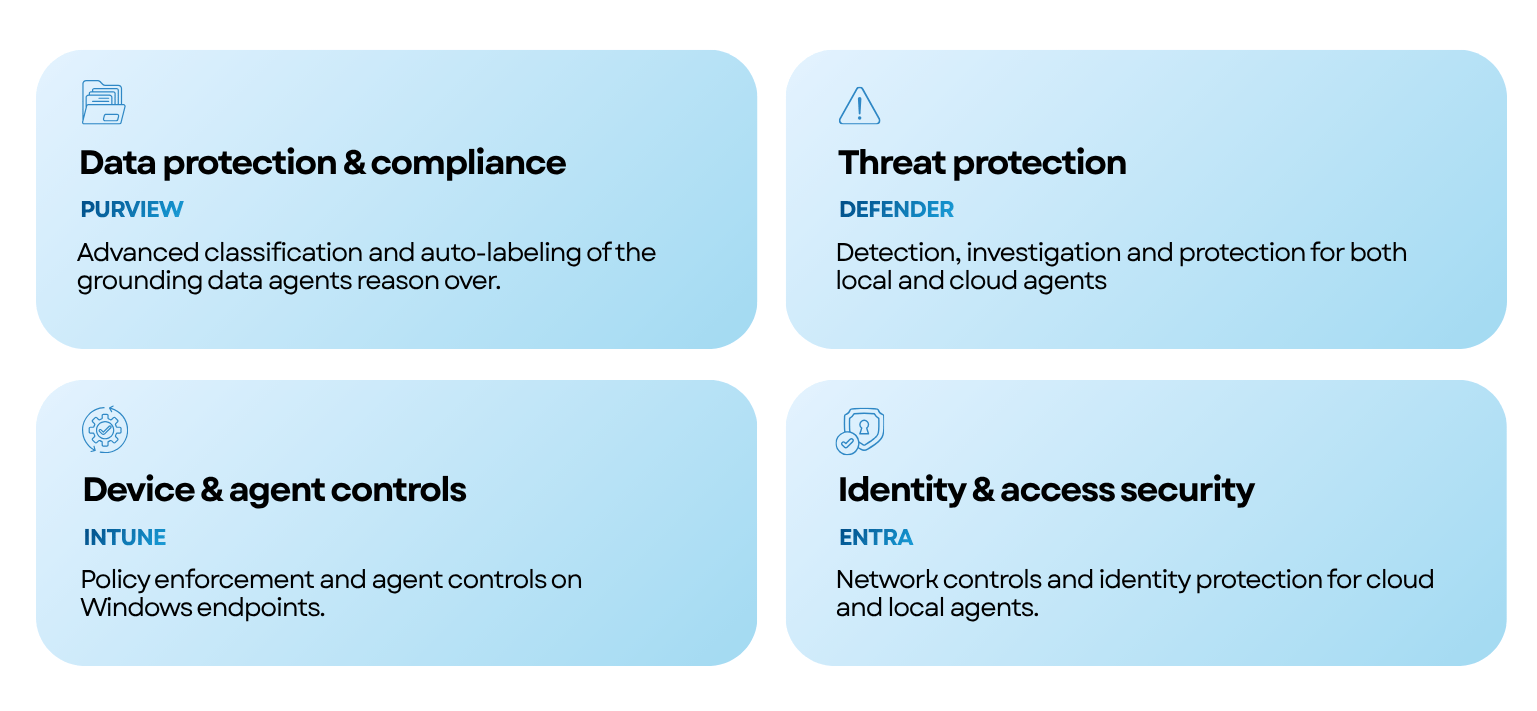
The reasoning is straightforward. Agent 365's value depends on capabilities delivered through those underlying licenses: auto-classification and labeling of grounding data through Purview, threat detection for local and cloud agents through Defender, agent and device policy enforcement through Intune, and identity protection and network controls through Entra. Without the foundation, the agents run without the guardrails which is not a position any partner wants to put a customer in.
 So, the headline isn't the price of Agent 365. It's that the entry point for selling it just moved up the stack.
What this changes for CSP partners
A clean single-SKU add-on has become a multi-product bundle. Every Agent 365 opportunity now carries a prerequisite behind it — an E5 or Business Premium upgrade, or a move to E7. That's a bigger deal and a more strategic conversation. It's also more moving parts to get right after the sale closes.
 Three things get harder the moment this is live:
You have to know which seats qualify before you can sell. Agent 365 won't enable against a seat that lacks the prerequisite. That turns the first step of every opportunity into a license-estate audit: which of this customer's users are already on E5 or Business Premium, and which need to be upgraded first? Get it wrong and you've sold something that won't turn on.
You're now provisioning and billing a bundle, not a line. E5 plus Agent 365, Business Premium plus Agent 365, or the full E7 consolidation - each is a different combination to provision, meter, reconcile against Partner Center, and margin-check. Multiply that across a customer base and the reconciliation surface grows fast. This is exactly where small, untracked discrepancies turn into real revenue leakage; one of our customers, GadellNet, recovered 2–3% of revenue that had been quietly slipping through exactly these kinds of gaps.
The E5-versus-E7 decision becomes a recurring advisory. For many customers, buying E5 and Agent 365 separately is the practical path. For others — particularly those already weighing Copilot and Entra Suite — E7 consolidates the whole stack into one SKU and removes the stitching entirely. That's a genuine consultative call, and you'll be making it again and again this year.
Where a revenue operations platform changes the equation
This is the kind of change that quietly raises the operational cost of doing business — unless the work of enforcing prerequisites, bundling products, and reconciling the result already runs through one system.
A revenue operations platform built natively on Microsoft Dataverse handles the prerequisite reality where it actually lives: at provisioning and billing. The bundle gets provisioned as a bundle. Partner Center stays in sync in real time, so what you've sold and what you're billing don't drift apart. The margin on a multi-SKU agent deal is visible rather than reconstructed at month-end. And the question Microsoft is now telling you to ask — which of my customer's seats are ready for Agent 365 and which aren't — becomes a matter of looking at your subscription data rather than exporting spreadsheets and guessing.
The point isn't that the prerequisite is a problem to be rescued from. It's that AI agents are becoming a real CSP revenue line, and the partners who can operationalize the licensing fastest are the ones who'll capture it. The complexity is the opportunity — provided your operations can absorb it.
Your Agent 365 readiness checklist
Before your next Agent 365 conversation:
- Audit the prerequisite gap. For each target customer, identify which users already hold E5 / Business Premium / F5-level Defender + Purview, and which need to be upgraded before Agent 365 will function.
- Decide the path per customer. E5 + Agent 365 separately, or E7 consolidation. Model both — the right answer depends on the customer's Copilot adoption and Entra footprint.
- Set up the bundle in your provisioning workflow so the prerequisite and the agent license are provisioned together, not in separate, error-prone steps.
- Confirm your reconciliation covers the full bundle, not just the agent SKU, so margin and Partner Center charges stay aligned from day one.
- Build the upgrade motion into your pipeline. Treat the base-license upgrade as part of the Agent 365 opportunity, not a separate sale.
The prerequisite is live now. The partners who treat it as an operational readiness exercise — not just a price-list update — are the ones who'll turn the agent wave into recurring revenue.
Work 365 is the revenue and operations platform for Microsoft CSP partners- the layer your billing, provisioning, subscription management, and customer engagement run through.